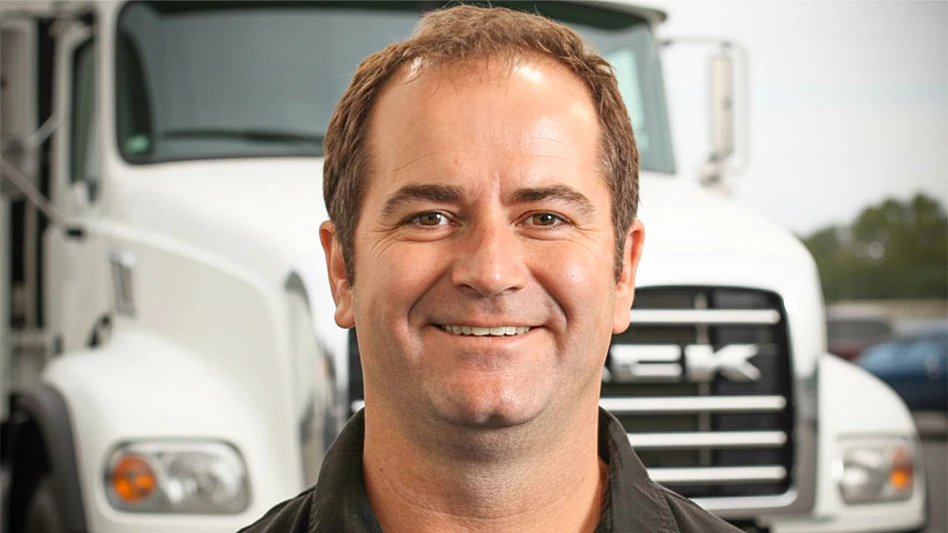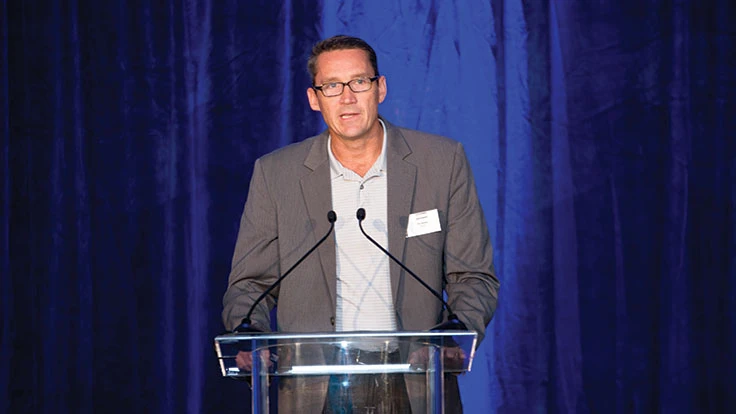
(Tim Barker, AECOM; Photo credit: Rob Kaufman)
The seventh annual Word Demolition Summit, Oct. 14, at the Marriott Biscayne Bay in Miami, drew some 280 delegates who heard from 10 speakers on various subjects relating to demolition projects and safety.
Organized by U.K.-based KHL Group, publisher of Demolition & Recycling International, in cooperation with the National Demolition Association (NDA), Washington, the day-long event began with a presentation from Tim Barker, program director, AECOM, Los Angeles, defining world-class demolition.
The company has been focusing on U.S. government decommissioning projects and the D4 approach, which includes Decommissioning, Deactivation, Decontamination and Demolition.
He said demolition firms fall into three categories: average, best in class and world class. The average approach is the low bid approach to win work. Best in class demolition firms, which Barker said is where most firms fall is when the lowest qualified bid is awarded work. “World-class is where the industry needs to go,” he says. He described it as “the best value project award where price is not the greatest award factor.
He said the U.S. Department of Defense has recognized a direct correlation with safety and profitability. “Safety is synonymous with profitability,” he said.
AECOM has been involved in the U.S. chemical demilitarization closure program which has been worth billions of dollars over two decades. He noted that the demolition is actually more dangerous than the chemicals and the company had one fatality.
The company wanted to make sure it had no new fatalities. A $300 million incentive was also tied to having no more fatalities. The company recorded zero injuries in two years, according to Barker, and still has the same playbook in place for preventing injuries.
“If you want to achieve great things, pass incentives down to the workers,” he told attendees. He also shared that premature collapses of structures was the top reason for fatalities in demolition. Dismantlement used to be the most fatal. What changed? According to Barker, crane operator and rigging certification became a requirement.
He also said of employees, “if they don’t understand that all accidents are truly preventable then let them go.”
He added, 80 percent of all injuries are the result of behavior and that it was more important to send an employee home intact than without a paycheck.
Additional advice he provided was upfront panning, “measure twice, cut once.” A trust and verify process will prevent errors down the road, he said..
He also advocated starting a lessons learned program and a “no blame” approach.
The World Demolition Summit was Oct. 14 in Miami.
Latest from Construction & Demolition Recycling
- Vermeer announces plan to build new facility in Des Moines metro area
- Capstar Disposal expands roll off dumpster rental services
- Supreme Court strikes down IEEPA tariffs
- Casella details facility closures, expansion efforts
- DPR Construction cuts ribbon on Silicon Valley office, prefab facility
- Constellium posts record Q4 adjusted EBITDA
- Amrize closes PB Materials acquisition
- QCC torches include customizable features