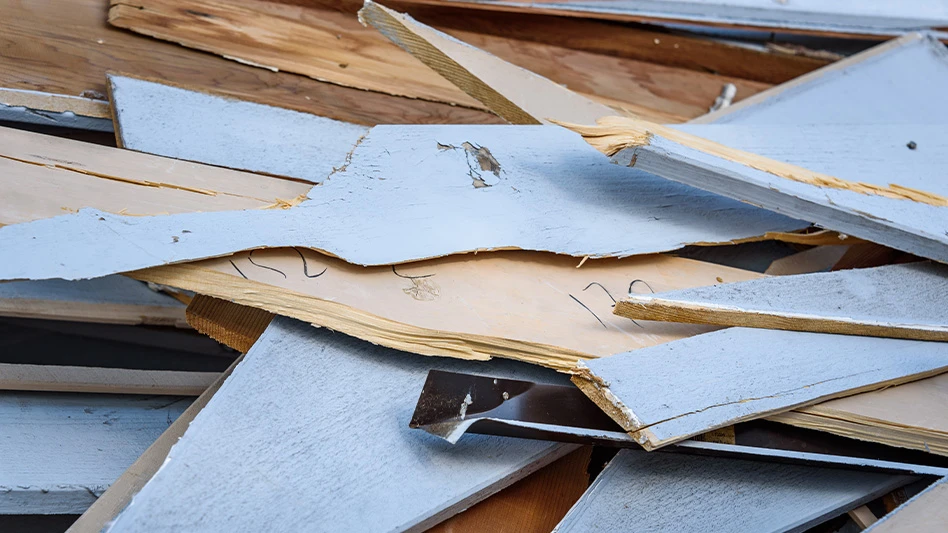
The New Hampshire legislature is considering a bill that would restrict incinerators using C&D wood to power the plant from operating within five miles of any residence, church, school, park, drinking water source or hospital. It also calls on any operators of the plant to use “best available technology,” the determination of which is up to state’s Department of Environmental Services (DES).
House Bill 1421 was introduced in response to a plan by a company called Bio Energy to restart and rejuvenate a power generating facility in Hopkinton, N.H. According to the New Hampshire Environmental Monitor, after the permit was issued for the facility it was discovered that former partner in the company was a convicted felon. It is against the law in the state for convicted felons to be associated with a recycling facility.
The Monitor reports that one of the permits Bio Energy received would allow it to release as much as 2.66 tons of lead into the air, reportedly more than the total amount of lead emitted by all other sources in the state.
The law proposed as a counter-measure “would pretty much ban any incinerators of C&D wood from being established in the state,” according to William Turley of the Construction Materials Recycling Association, Lisle, Ill. Such a ban would severely limit available outlets for C&D recyclers’ products, he notes. “Five miles from anything usually makes such plants economically unfeasible, and in a state the size of New Hampshire, how do you get five miles from everything?”
In addition, the clause regarding use of the “best available” technology will make the plants less than cost effective, he adds. “The issue with lead can be contained by proper fuel selection and good incinerator techniques,” says Turley.
The CMRA Issues & Education Fund plans to respond to the proposed bill, according to Turley.
Latest from Construction & Demolition Recycling
- Vecoplan to present modular solutions at IFAT 2026
- Terex Ecotec appoints Bradley Equipment as Texas distributor
- Greenwave raises revenue but loses money in Q2 2025
- Recycled steel prices hold steady
- John Deere launches ‘Building America’ excavator contest
- Triumvirate Environmental acquires Environmental Waste Minimization
- Coastal Waste & Recycling expands recycling operations with Machinex
- Reconomy acquires German-based GfAW