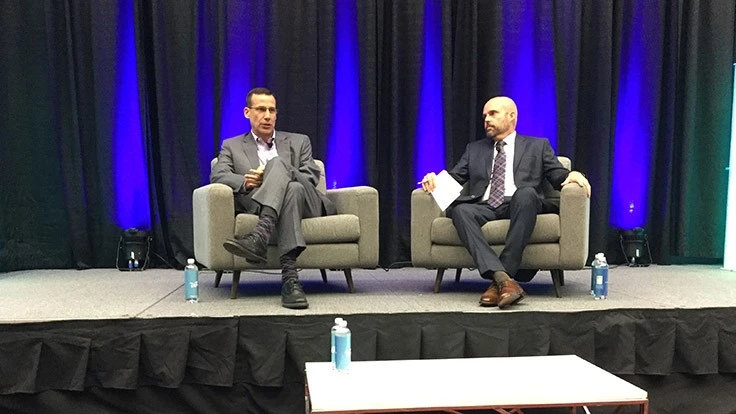
National Waste & Recycling Association (NWRA) President and CEO Darrell Smith sat down with WCA Waste Corp. CEO Bill Caesar May 7 at WasteExpo for a fireside chat that covered a range of topics, including how to lead, dealing with shifting recycling markets, hiring challenges and how to change corporate culture in a waste organization.
Here are some highlights from the discussion:
Darrell Smith: You had your entree into the corporate and consulting world working with companies like McKinsey & Company and Macquarie. Can you tell us how you [got started and how these experiences taught you to succeed in the waste management industry]?
Bill Caesar: What you carry with you is how you look at an industry, whatever industry that is, and decide what’s important and what the drivers of success are. What are the things you have to do to succeed and what metrics do you need to look at? What are the environments that you’re working in? Who are the competitors? All these things about how you look at a problem or an industry are things that are highly leverageable. … The [details change], but all the other things are very transferable and were highly useful in my transition from consulting into the waste management field.
DS: What kind of leader are you? How do you motivate people?
BC: There are a couple things I would say describe my leadership style. The first one is honesty. I make a point of ensuring that everybody knows [the reasons behind] what I think is important. I’ll always be straight with them, and I will always be fair. I can’t claim that I will always be patient, but I will always be fair and honest—both for the people that work for me, and for the people that I work for because its important as a manager [to know] that you don’t just manage people, you’re managing the board, you’re managing the people who own the company and are invested in it. You have to be the same person to groups on both sides of that equation. And that philosophy has served me well to this point.
I don’t get questioned on whether or not what I believe in is for the right reasons. If you were to ask me what my approach to management is—there is management by walking around [and learning from immersion], and I do a little bit of that—but I manage by asking questions. I ask questions all the time. Ninety percent of the time I don’t know the answer to those questions—I’m not testing anybody—I ask questions because I honestly want to know why something happened, what does it mean, what did we learn, how are we going to move forward, etc., but I don’t look back on much of anything. I may not be the most optimistic person, but I am definitely a forward-thinking person. When [mistakes happen], we figure out how to move on but we don’t dwell on those things. But I do want us to learn from things when we make mistakes and I want our people to understand how things came to be so we can better manage them.
DS: How’s WCA doing recovering from challenges with the recycling market?
BC: I think with WCA, recycling accounts for 1.8 percent of our revenue. It is not the most important thing I do every day. However, even at 1.8 percent, it has a meaningful impact in delivering the financial performance my board is looking for. … We’re doing the best we can. If there was a secret to recycling, it would’ve gotten out by now. You need to force the people that are bringing you material to pay you more for it. You don’t give them rebates anymore. You improve your operations, and you try like hell to get somebody to buy the stuff you’re making—it’s not that complicated. It can be real complicated if you want it to be, but at the end of the day, you need to run your plant as efficiently as possible, don’t pay for crappy material and sell everything that you can, if you can. At the end of the day, the vast majority of the value that you create [from recycling] is a function of things that are completely out of your hands.
DS: Can you talk about your recruiting efforts? What is WCA doing to manage its [hiring needs]?
BC: A year ago, we put together a group of people to look at what the drivers were in our whole recruitment process. We tried to understand what we could be doing better in how we attract people—what do our benefits need to be, what do our comps need to be, how are we going to promote the company, what happens when our employees show up on their first day of work, how do we introduce them to WCA, and how do we try to get them to realize that we not only want them to work for us but we want them to be part of us? We found that we were lacking in that first impression that we made with employees. We realized we probably didn’t train our front-line supervisors to help new employees get started. We probably didn’t totally think through how to deal with employees coming from outside the industry … so it was a broad-based effort for us. We called [our efforts to improve our recruitment process] Project Genesis because [it was all about improving what we did] starting from the beginning of your introduction to WCA. I can’t tell you that as a result of this that we’re in the top quartile, but we’re a lot better than we were.
DS: How does WCA approach safety?
BC: If there is one piece of advice I’d give the industry, it would be to make sure that your employees know that their lives are worth more than any piece of equipment you own, and that they should never put themselves in a position where they could get hurt because [they fear] a piece of equipment is going to get damaged. I don’t feel like we can do a lot about distracted drivers, we can’t fix that, but I can make sure my people know that avoiding damage isn’t worth their lives.
During the audience Q&A portion of the session, an audience member asked about how a waste company can change its culture over time.
BC: I start with leadership. I think it is very hard for front-line people to change what they’re doing if front-line leadership hasn’t bought into it. When I came to WCA, we made some changes in leadership. Some because it was clear that the individual was incapable of doing the job that we needed them to do, some because the person doing the job realized that maybe they didn’t want to do it in this environment, and that was good. I feel so good about the team I have today. We have capable people who are smart, who are doing what they need to do and they care about people—that makes all the difference.