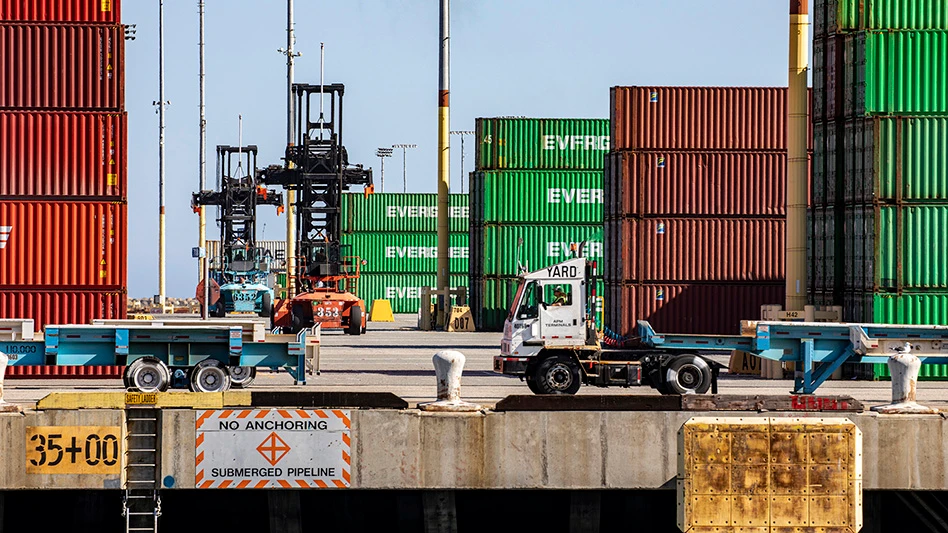
Photo courtesy of the Port of Los Angeles
Opposition to the blizzard of tariffs introduced by the administration of President Donald Trump this year perhaps can be described as both quiet and informal, but that situation appears poised to change in 2026.
A four-part (so far) essay series by the United States Chamber of Commerce titled “How Tariffs Risk Hollowing Out American Manufacturing” has been posted to its website in November and December.
Two of those four essays focus on the Trump administration’s 50 percent tariff on inbound aluminum, with one of the two taking a particularly close look at the effects of placing a tariff on aluminum made in Canada.
In the first essay in the series, posted Nov. 13, U.S. Chamber staff member John G. Murphy writes in part, “Steel and aluminum tariffs (50 percent) have sent the U.S. price of steel to levels twice as high as other markets, and aluminum prices have soared in lockstep with the tariffs.
“For every one U.S. worker employed in steel production, there are as many as 80 in downstream manufacturing industries that are harmed by these higher prices (and the ratio is 1-to-177 in aluminum).”
In the same essay, Murphy also singles out 25 percent tariffs on some copper and lumber products as having added to the already high cost of materials for U.S. manufacturers.
In his most recent essay, posted Dec. 18, Murphy portrays summer 2025 Commerce Department inclusions tariffs on products that contain steel and aluminum as adding costs and paperwork burdens for U.S. companies.
That round of tariffs led to a letter to Department of Commerce Under Secretary of Commerce for Industry and Security Jeffrey Kessler from 40 business trade associations, including several with a recycling industry presence.
Among the signees of that letter were the Washington-based Recycled Materials Association (ReMA) and the National Waste & Recycling Association (NWRA), also based in Washington.
Trade groups focused on the equipment sector, which provides material handling and sorting machinery to recycling companies that can be built overseas, also signed the letter, including the Milwaukee-based Association of Equipment Manufacturers (AEM) and the Associated Equipment Distributors (AED), which is based in Illinois.
“The sudden expansion of tariffs with limited industry consultation increases costs by generating significant compliance burdens for businesses of all sizes, including those that do not produce steel and aluminum products,” the letter says in part.
Numerous Trump administration tariffs, including the 50 percent levy on steel, also have gained support from some companies, organizations and individuals in the metals industry.
In its May 30 news release, the Washington-based Steel Manufacturers Association (SMA) applauded the raising of the steel tariff from 25 percent to 50 percent, saying, “American-made steel is at the heart of President Trump’s plan to revitalize domestic manufacturing and return our country to an economic powerhouse.
“Since the tariffs were first announced in 2018, our industry has invested over $20 billion in growth and modernization. Increasing the tariffs will promote greater investment and ensure that steel imports do not surge into the U.S. market.”
At a late October recycling industry convention, CEO George Adams of California-based SA Recycling said the Trump administration tariffs on inbound steel “are single-handedly saving our steel industry in the U.S."
“If you can take our scrap and ship it and then can make steel and make it cheaper and ship it back, something is wrong," Adams said, expressing support for policies that can bolster what he called a “hollowed out” U.S. manufacturing sector.
Another source of tariff scrutiny is the Tariffs Cost US campaign, which says it is dedicated to providing the public with reliable, comprehensive information about global trade and tariffs and their impact on both businesses and consumers.
The campaign’s website lists Trade Connects US as the operator of the site. The Tariffs Cost US Linkedin page lists Washington as its home city, has posts dating back up to six months and has about 215 followers.
Latest from Construction & Demolition Recycling
- Vermeer announces plan to build new facility in Des Moines metro area
- Capstar Disposal expands roll off dumpster rental services
- Supreme Court strikes down IEEPA tariffs
- Casella details facility closures, expansion efforts
- DPR Construction cuts ribbon on Silicon Valley office, prefab facility
- Constellium posts record Q4 adjusted EBITDA
- Amrize closes PB Materials acquisition
- QCC torches include customizable features