Total
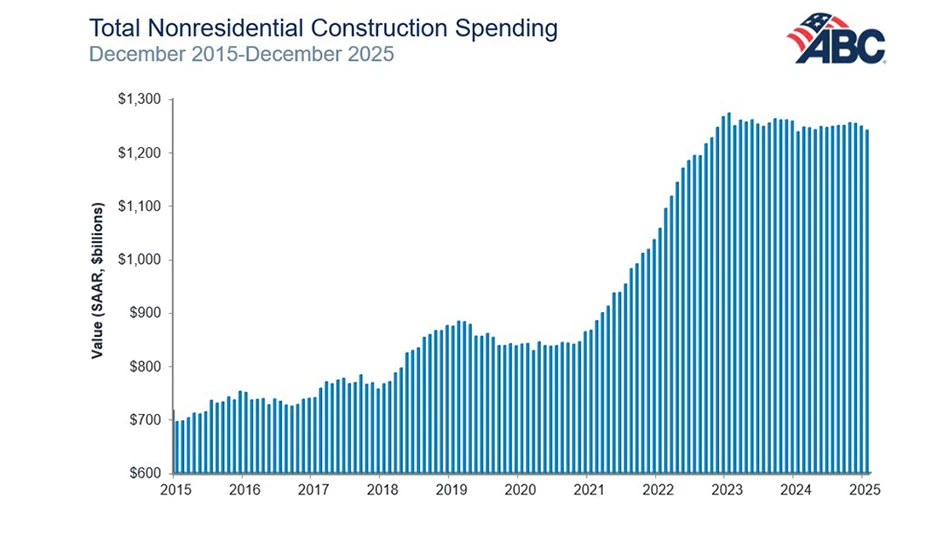
Total private construction for the month was down 1 percent, while business construction showed some improvement with a 1.3 percent gain.
Gains in the nonresidential sector brighten a gloomy outlook, says Ken Simonson, chief economist for the Associated General Contractors of America (AGC). “Nonresidential construction employment eked out a small gain in January implying that the spending rise of 2007 will continue,” he says. “A 3.5 percent jump in employment of architects and engineers since January 2007 also suggests that nonresidential activity will remain positive.”
Total construction employment fell by 27,000 in January, according to Simonson, but those losses occurred in the residential building sector and specialty trades. “Employment in the three nonresidential categories—nonresidential building, specialty trades, plus heavy and civil engineering—edged up 1,300,” he says.
“The reality is a good deal better for nonresidential construction employment than BLS indicates,” Simonson continues. “Census figures for December show nonresidential construction spending jumped almost 16 percent from a year earlier, which could only have occurred with a sharp rise in employment. The ‘missing’ employees work for specialty trade contractors—firms that entered the database as residential but are now busy installing wallboard, wiring and plumbing in schools, hotels and offices rather than houses.
“Residential spending in December fell 20 percent from a year before,” he notes. “That suggests residential employment probably fell by roughly 20 percent as well, or 660,000 jobs, not the 240,000 that BLS counted. If these 420,000 ‘residential’ specialty trade contractors were included in the nonresidential workforce, nonresidential construction employment for the past year would show a hefty gain of about 8 percent. That would be consistent with the rise in nonresidential spending that Census reported.
“The Census numbers show growth, mostly at double-digit rates, in 15 of 16 nonresidential categories—everything except religious structures, which are closely linked to new housing,” Simonson continues. “For 2008, I expect continued expansion in power, energy, communication, hospital and higher education construction, and a modest increase in the nonresidential total, before taking cost escalation into account.
Unfortunately, materials costs are accelerating again, particularly diesel fuel and steel,” he says. “States have identified billions of dollars of infrastructure projects that are ready to go if the federal government will supply more funding. If Congress is intent on passing a ‘stimulus’ bill, it should include infrastructure money to keep construction workers on the job and offset some of states’ lost purchasing power.”
More information is available at www.agc.org.
Latest from Construction & Demolition Recycling
- Terex Ecotec appoints Bradley Equipment as Texas distributor
- Greenwave raises revenue but loses money in Q2 2025
- Recycled steel prices hold steady
- John Deere launches ‘Building America’ excavator contest
- Triumvirate Environmental acquires Environmental Waste Minimization
- Coastal Waste & Recycling expands recycling operations with Machinex
- Reconomy acquires German-based GfAW
- CommanderAI launches HaulerCentral database