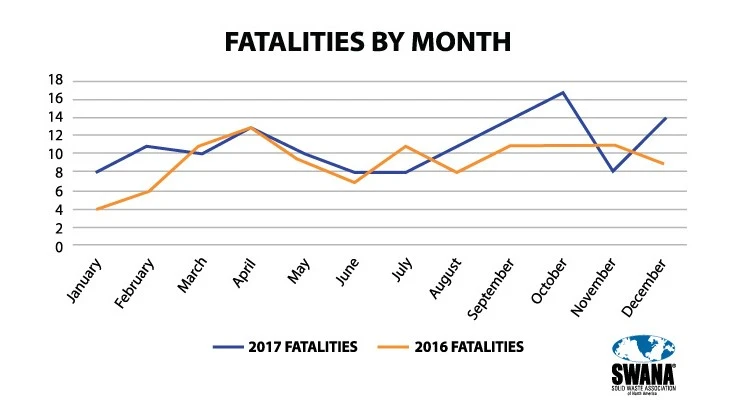
The Solid Waste Association of North America (SWANA), Silver Spring, Maryland, has released its 2017 solid waste industry fatality data, noting 132 recorded fatalities, an 18 percent increase in total fatalities compared with 2016, with almost all incidents occurring in the United States.
SWANA says it records and investigates fatal incidents that involve solid waste management as part of its mission and releases industry data to create a better understanding of the state of safety in the solid waste industry and where improvements are necessary.
In 2017, 94 members of the public killed and 38 workers were killed on the job, with more than 75 percent of the incidents involving a private sector solid waste company.
October 2017 had the most fatalities at 17, though no month had fewer than eight. Compared with 2016, April had the most with 13 fatalities, and January had the least with four.
“I am disappointed in the waste industry’s safety performance in 2017 based on the fatality-related data that SWANA maintains,” David Biderman, SWANA executive director and CEO, says. “There was an unacceptable number of preventable fatal incidents involving our trucks and equipment.”
Most of the deaths involving a member of the public occurred on the roadways, with 60 percent involving a solid waste vehicle and at least one other vehicle. Sixteen of these cases involved the other vehicle crossing into the lane of an oncoming waste vehicle. Ultimately, there were 94 third-party fatalities: 57 were drivers of or passengers in other vehicles, 23 were pedestrians, eight were bicyclists, four were motorcyclists and two occurred at disposal facilities.
Of the 38 workers who died on the job in 2017, approximately 60 percent were killed during collection and 21 percent died at a landfill, with the remainder occurring at material recovery facilities (MRFs), transfer stations and other locations. A disproportionate number of these incidents involved small companies, usually haulers with fewer than 20 trucks, SWANA says. Half of the fatalities that occurred at landfills were drivers working on or around their trucks at the time of the incident, and two of them were spotters.
“We need to do a better job of communicating to frontline workers the importance of wearing safety belts while in the truck, lockout-tagout and backing carefully in order to mitigate the risk of preventable accidents,” Biderman says.
Consistent with previous years, solid waste workers died in a wide variety of ways, including being struck by their own truck, falling off the riding step and colliding with other vehicles on the road and equipment at disposal facilities. In four of the 37 fatal incidents, a collection worker was struck and killed by another vehicle.
These industry statistics are why SWANA supports recent efforts to pass Slow Down to Get Around (SDTGA) legislation in several states, including South Carolina, Kansas, Ohio and Maryland, the association says. Recently passed in Nebraska, 17 states now have SDTGA laws on the books.
The first two worker fatalities in 2017 were both in Maryland, including the death of Laurel employee Marcus Colbert. Laurel Mayor Craig Moe testified at the Maryland statehouse to help pass the state’s SDTGA bill, which is expected to be signed this spring.
“The city of Laurel was grateful and privileged to work with the Solid Waste Association of North America on Maryland’s new legislation. Motor Vehicles—Operation When Approaching Vehicle with Visual Signals will raise public awareness and provide a consistent message to motorists to pay attention to their surroundings to slow down to get around,” Moe says. “This legislation will allow workers on our roadways to successfully complete their assignments safely and to return to their families at the end of the workday.”
SWANA urges industry professionals to use its safety resources, including the Five to Stay Alive safety series, weekly Safety Monday mailings and safety events and trainings across North America, to move the solid waste industry off the federal government’s list of most dangerous jobs.
The 2017 solid waste industry fatality charts are available to download at https://bit.ly/2vyqcuu.
To learn more about SWANA's safety program, visit swana.org/safety.
Latest from Construction & Demolition Recycling
- Vecoplan to present modular solutions at IFAT 2026
- Terex Ecotec appoints Bradley Equipment as Texas distributor
- Greenwave raises revenue but loses money in Q2 2025
- Recycled steel prices hold steady
- John Deere launches ‘Building America’ excavator contest
- Triumvirate Environmental acquires Environmental Waste Minimization
- Coastal Waste & Recycling expands recycling operations with Machinex
- Reconomy acquires German-based GfAW