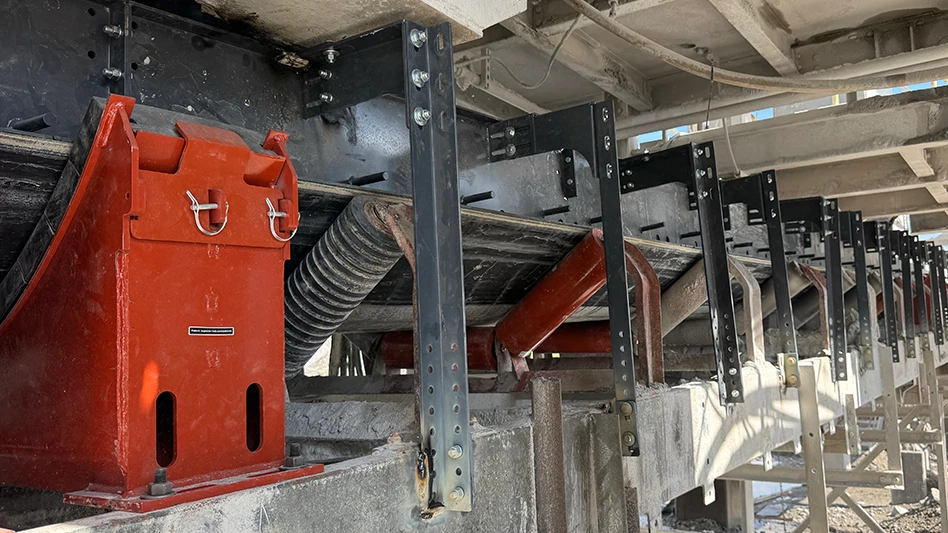
Photo courtesy of Superior Industries Inc.
Superior Industries Inc., Morris, Minnesota, has introduced adjustable skirtboard systems and RockGuard skirting liners it says can be used in multiple conveyor configurations, without the need for any custom fabrication, to offer dust control assistance at aggregates production and recycling sites.
The equipment provider says its new offerings can help aggregates producers and recyclers prepare for stricter Mine Safety and Health Administration (MSHA) regulations on respirable crystalline silica and airborne dust.
Superior says the new dust control features may be particularly helpful at conveyor transfer points and load zones.
“Many new conveyors arrive on site with standard OEM skirtboards that simply aren’t long or tall enough for real-world applications,” says Chris Mullen, a conveyor components territory manager for Superior in the southeastern United States.
“Because MSHA considers dust control an engineering responsibility of the mine operator, it requires turning what is often an open, uncontrolled environment into a sealed system that manages airflow and dust,” says Mullen.
Superior’s adjustable skirtboards can provide what the company calls affordable transfer point and load zone containment, cutting dust, spillage, cleanup and worker risks.
The firm says its skirtboard systems are engineered with a modular, adjustable design that allows operators to fine-tune length and height for each conveyor application, while creating a more effective seal along the belt to reduce fugitive dust.
“Eliminating the need for custom engineering and costly installation, skirtboard systems are easily adjustable in three-inch increments,” states Supperior, adding the system’s mounting legs are designed for easy onsite trimming and fitting to help simplify installation.
Superior says its RockGuard skirting liners can complement skirtboards by containing material within the transfer zone while reducing dust, spillage and preventing material buildup on the shelf of the liner.
“By combining adjustable skirtboards with RockGuard liners, producers protect the skirtboard structure itself, extending the life of the entire skirting system while reducing rebuild cycles and long-term maintenance costs,” says Mullen.
At sites where dust levels could remain elevated, the modular skirtboard system can be expanded with belt covers, tail enclosures or a stilling box, according to Superior.
The stilling box controls dust mechanically, requiring no water or electrical power, which can reduce maintenance demands and avoid moisture-related belt wear. The components can be added at any stage of the conveyor’s life cycle, giving operators flexibility as site conditions evolve, says Superior.
Since their introduction, Superior’s adjustable skirtboards have seen strong adoption, particularly among producers proactively preparing for MSHA compliance.
“When you see that level of investment, it tells us that producers are taking the new silica regulations seriously—not just because of potential citations, but because of employee safety and long-term operational risk,” says Mullen.
MSHA citations for silica exposure can carry significant financial penalties, according to Superior, and repeat violations may result in increased inspection frequency.
Latest from Construction & Demolition Recycling
- Recology demonstrates composting techniques
- MB Crusher at ConExpo
- Reclaiming rebar from concrete with use of a self-cleaning suspended overhead magnet
- Suspended magnet options galore
- European Demolition Association selects Dublin for annual convention
- Are you missing out on money?
- Oregon shopping center could be nearing demolition
- Fraser Valley Junk Solutions expands service availability