Photo courtesy of One Click LCA
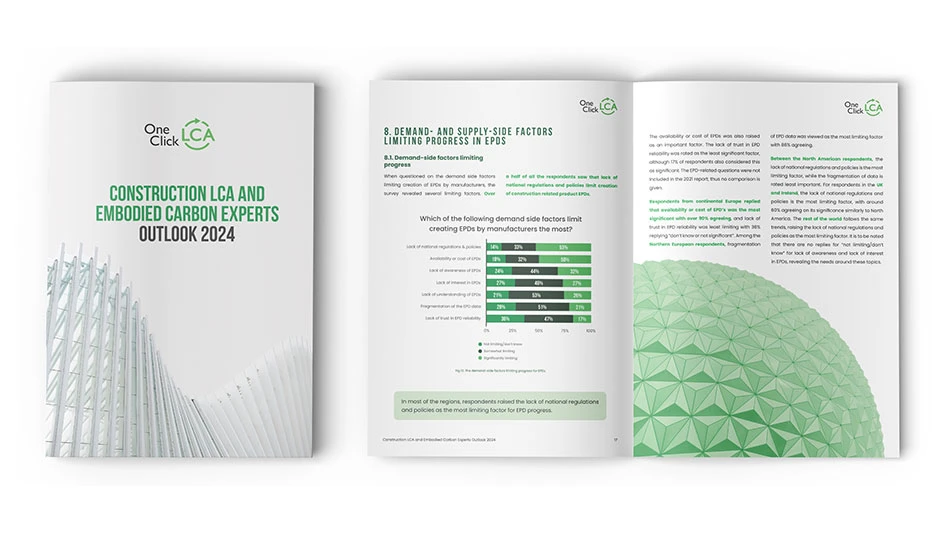
A new international study on decarbonizing the construction value chain from Finland-based decarbonization tech platform One Click LCA finds that 59 percent of respondents expect at least a 10 percent reduction in embodied carbon emissions in buildings by conducting life-cycle assessments (LCAs).
At the same time, according to the "Construction LCA and Embodied Carbon Experts Outlook 2024" report, 83 percent of respondents state that a lack of national regulation and policies is a barrier to LCA adoption. Furthermore, more than 80 percent of respondents highlighted the need for more awareness from developers and investors as a significant hurdle in making progress in reducing embodied carbon emissions.
Buildings account for about 40 percent of total global energy use and emissions, according to the World Economic Forum, Geneva, Switzerland, stemming from both embodied and operational sources.
The most commonly understood source is carbon emissions from operating and using a building over its lifetime. Embodied carbon is carbon dioxide produced from manufacturing, transporting and installing building materials—the carbon footprint of a construction project before it becomes operational.
LCA is a tool for calculating the environmental impact of processes and products during their life cycle. LCA can help to understand and minimize negative environmental impacts from construction and manufacturing and identify and reduce embodied carbon emissions when it comes to material choices to the construction process itself.
RELATED: North American aluminum production's carbon footprint has declined considerably
On the supply side, 87 percent of respondents rated a lack of manufacturer environmental product declarations (EPDs) as the most limiting factor to LCAs and embodied carbon reduction. EPDs show a product’s environmental impact and performance, including carbon footprint and resource consumption, in manufacturing and other life-cycle stages.
“Energy efficiency has lowered operational carbon emissions, but reducing embodied carbon is just as important. These are emissions that are being released into the atmosphere right now,” One Click LCA founder and CEO Panu Pasanen says. “We are in the middle of the largest wave of building and infrastructure growth in history, and global building stock is expected to double by 2060, the equivalent of constructing a New York City every month. Reducing embodied carbon immediately combats climate change and is critical for decarbonizing the construction sector.”
A lack of LCA adoption and scare resources also hinder progress, the study finds. Findings report 47 percent of respondents perform LCAs for less than 5 percent of their projects. Simultaneously, almost half of the respondents acknowledge that their companies’ resources were insufficient to meet current demand for LCA and embodied carbon reduction. However, 65 percent expressed their willingness to hire one or more individuals to tackle embodied carbon within the next year.
Key factors driving the reduction of time spent on assessments and optimization in the future are LCA automation and other software such as BIM (building information modeling) tools, according to One Click LCA. To view the full report, click here.
Latest from Construction & Demolition Recycling
- Martin Marietta, Quikrete Holdings exchange aggregates assets
- Lakeshore Recycling Systems, MCS Recycling achieve RCI certification
- Iron Woman Logistics Services awarded grant to build Colorado C&D recycling facility
- Collective Waste Solutions acquires Alcop Resource Recycling transfer station
- Construction hiring remains slow in January
- Sybilion seeks to help manufacturers confidently address volatility
- Construction backlog rebounds in February
- USTR to study additional steel, aluminum tariffs