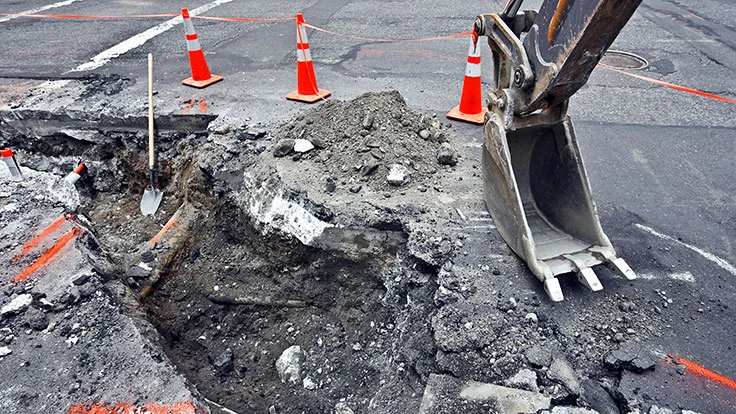
Roads in Ontario are downgrading in quality, and researchers say it’s the mix of recycled engine oil, shingles and ground pavement,a report in the Globe and Mail says.
Simon Hesp, professor of chemical engineering at Queen’s University in Kingston, Ontario, told the Globe and Mail that pavement is an organic material that slowly deteriorates, and that there have been big decreases in its life cycle over the last 20 to 25 years.
According to the report, Hesp said that roads should last 15 to 20 years without cracking, but they are now cracking during the first winter. Tough recent winters and increased traffic are partially to blame, but the real culprit is recycling, Hesp said in the report.
Asphalt is typically 95 per cent sand and gravel glued together with 5 per cent cement. That cement is made of bitumen, the thick sludge left over after refining petroleum. Wholesalers add recycled motor oil to the glue to cut costs, and it gets promoted as a green way to dispose of recycled oil, Hesp told The Globe and Mail.
Some contracts between municipalities and pavement companies allow up to 20 percent of recycled oil in pavement, the report says, and the city of Ontario does not have official guidelines on it. Hesp’s research group discovered oil in asphalt when they started to find metals, such as zinc, in roads that had failed. These metals are found in motor oil, which is a lubricant that causes the pavement to lose resiliency.
The city of Toronto says in the report it spent $2.1 million fixing more than 85,000 potholes from Jan. 1 until May 18 this year. So far, there are fewer repairs than last year. In the same period in 2015, it spent $2.3 million fixing nearly 118,000 potholes.
In all of 2015, it spent $4.7 million fixing 254,000 potholes, according to the report. The worst year for potholes in the past 10 years was 2014, during which the city spent $5.8-million to fix 365,000 potholes.
Latest from Construction & Demolition Recycling
- Waste Pro files brief supporting pause of FMCSA CDL eligibility rule
- Des Moines project utilizes recycled wind turbine blades
- Vecoplan to present modular solutions at IFAT 2026
- Terex Ecotec appoints Bradley Equipment as Texas distributor
- Greenwave raises revenue but loses money in Q2 2025
- Recycled steel prices hold steady
- John Deere launches ‘Building America’ excavator contest
- Triumvirate Environmental acquires Environmental Waste Minimization