Photo by Brian Taylor
Metals recycling companies are poised to pay an increasing amount of attention to trade measures as governments around the world propose and enact policies that affect the flow and pricing of secondary commodities including recycled steel, aluminum and copper.
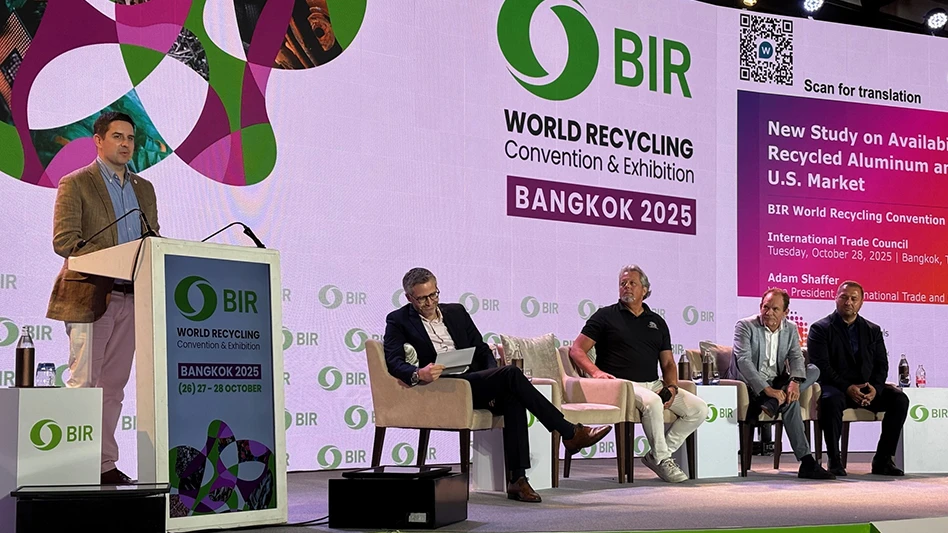
Presenters and panelists at the Bureau of International Recycling (BIR) International Trade Council meeting in late October in Bangkok expressed varying points of view about trade issues ranging from tariffs on imported metal introduced by President Donald Trump to recycled metal export restrictions being considered in the European Union.
George Adams, CEO of U.S.-based SA Recycling, said the Trump administration tariffs on inbound steel “are single-handedly saving our steel industry in the U.S."
“If you can take our scrap and ship it and then can make steel and make it cheaper and ship it back, something is wrong," he said.
Adams expressed support for policies that can bolster what he called a “hollowed out” U.S. manufacturing sector. Now, in California, they’re building a steel mill, according to Adams, referring to a new scrap-fed electric arc furnace (EAF) steel mill being built by Pacific Steel Group in Mojave, California.
Emmanuel Katrakis of the Belgium-based Galloo Group and the Brussels-based Recycling Europe organization (formerly EuRIC) said a trade measure being considered by the EU—restrictions on exported scrap metal—would not be helpful to recyclers there.
In the steel sector, Katrakis said export volumes of ferrous scrap from Europe each year fluctuate depending on how much demand there is on the continent. When European mills consume more, “there is automatically a decrease in exports; this is perfect circularity,” he said.
In the nonferrous sector, Adam Shaffer of the Washington-based Recycled Materials Association (ReMA) told delegates the Aluminum Association in the U.S. has proposed export restrictions on aluminum scrap there.
Shaffer said earlier this year, a report submitted to Trump had recommended red metal scrap export restrictions as a potential policy move, but the president chose not to impose restrictions.
ReMA is preparing a report for administration officials, legislators and other policymakers that will quantify what Shaffer called the “significant” volume of aluminum and copper scrap reserves in the U.S. that indicate export restrictions are unnecessary.
Murat Bayram, who works from Germany for United Kingdom-based EMR Ltd., said metals producers and recyclers should not be confronting each other on trade policy, adding that primary metals producers in Europe have seized on the scrap availability issue incorrectly.
“The problem is not the recycling industry; it’s the EU economy,” Bayram said.
The recycled metals trader said high energy prices remain the biggest problem for European melt shop operations, adding that metals producers there “simply don’t have the orders,” and keeping more scrap onshore would not remedy that.
Regarding global trade patterns, Mark Sellier said several years of sometimes shifting scrap import restrictions in China have been causing the migration of processing and melt shop capacity from China to Southeast Asia for several years.
This decade, India is rising in terms of its significance as a scrap buyer, according to Sellier, while he says he is hearing anecdotal stories of customs officials in China holding up recent shipments to scrutinize the source of origin documentation for inbound scrap shipments.
Katrakis said in addition to its discussed scrap export restrictions, the EU is considering melt-and-pour rules that would favor domestic metals production. Whether trade barriers exist on the outbound or inbound side, Katrakis said he fears a decline in scrap collection of recycled metals prices are artificially lowered for the sake of regional metals producers.
Adams pointed to China as a negative influence, saying it was putting 120 million tons per year of steel rebar onto global markets at subsidized, low prices.
“If that wasn’t out there, the [global] price of steel would be higher,” he said.
The BIR October 2025 World Recycling Convention & Exhibition was at the Centara Grand Convention Centre at Centralworld in Bangkok on Oct. 26-28.
Latest from Construction & Demolition Recycling
- Lakeshore Recycling Systems, MCS Recycling achieve RCI certification
- Iron Woman Logistics Services awarded grant to build Colorado C&D recycling facility
- Collective Waste Solutions acquires Alcop Resource Recycling transfer station
- Construction hiring remains slow in January
- Sybilion seeks to help manufacturers confidently address volatility
- Construction backlog rebounds in February
- USTR to study additional steel, aluminum tariffs
- Shawmut commemorates National Women in Construction Week