The U.S. Senate Subcommittee on Public Land and Forests has held a hearing to consider the use of silver compounds to treat wood used in exterior construction and landscaping applications.Senate bill 432, known as the Public Lands Production Research Act of 2003, has been authored by Senator Larry Craig (R-ID).
The bill would authorize the Forest Products Laboratory of the U.S. Forest Service to study the effectiveness of silver-based biocides as a wood preservative treatment. According to proponents of the compounds, “silver biocides could serve as a viable, safe, and cost-effective wood preservative.”
The silver industry’s opportunity comes at the expense of chromated copper arsenate (CCA)-based wood preservatives, which are being phased out after a 2002 agreement between the U.S. EPA and manufacturers of treated wood and makers of wood preservative chemicals.
Under that agreement, CCA-based wood preservatives in pressure-treated wood are being phased out by the end of this calendar year.
The transition affects a number of lumber markets, including wood used in play structures, decks, picnic tables, landscaping timbers, residential fencing, patios and walkways/boardwalks.
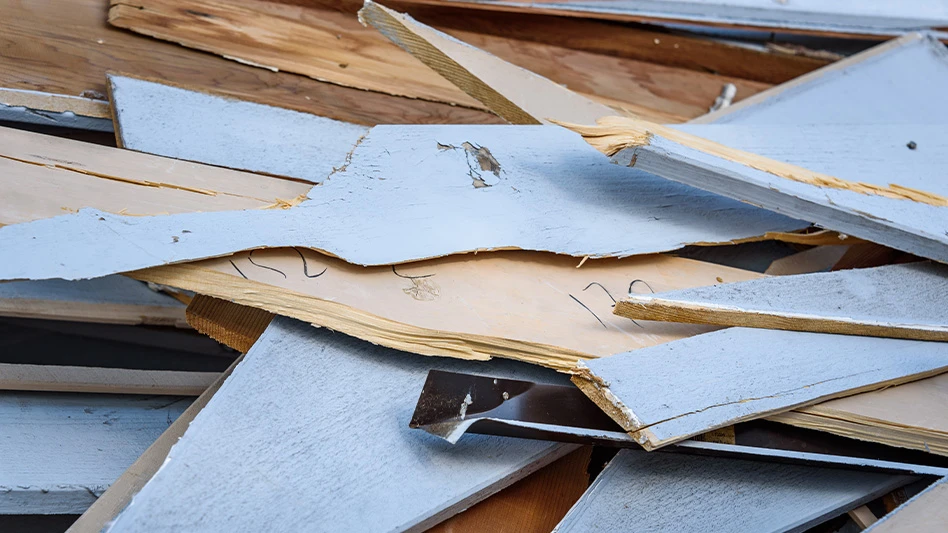
The adoption of a new, less toxic treated wood material is of interest to construction and demolition debris (C&D) recyclers who handle wood, as they do not want a repeat of problems associated with keeping CCA-treated wood out of their products.
According to a news release from the Silver Institute, Washington, the news is also of interest to investors, refiners and other participants in that precious metals market. Should research prove this application effective and safe, as many as 80 million ounces of silver per year could be used in pressure-treated wood applications.
Dr. Jeffrey Ellis of Plantation, Fla., a consultant to the chemicals and plastics technology industries, testified before the Senate subcommittee that initial research should cover a number of areas. “At present, research is needed first to establish that silver will meet the performance requirements,” he remarked. “This research will include: 1) measurements of performance in air, soil and in fresh water and marine environments; 2) resistance to fungi, insects, and other wood destroying organisms; and 3) leaching and toxicology studies.”
Latest from Construction & Demolition Recycling
- Vecoplan to present modular solutions at IFAT 2026
- Terex Ecotec appoints Bradley Equipment as Texas distributor
- Greenwave raises revenue but loses money in Q2 2025
- Recycled steel prices hold steady
- John Deere launches ‘Building America’ excavator contest
- Triumvirate Environmental acquires Environmental Waste Minimization
- Coastal Waste & Recycling expands recycling operations with Machinex
- Reconomy acquires German-based GfAW