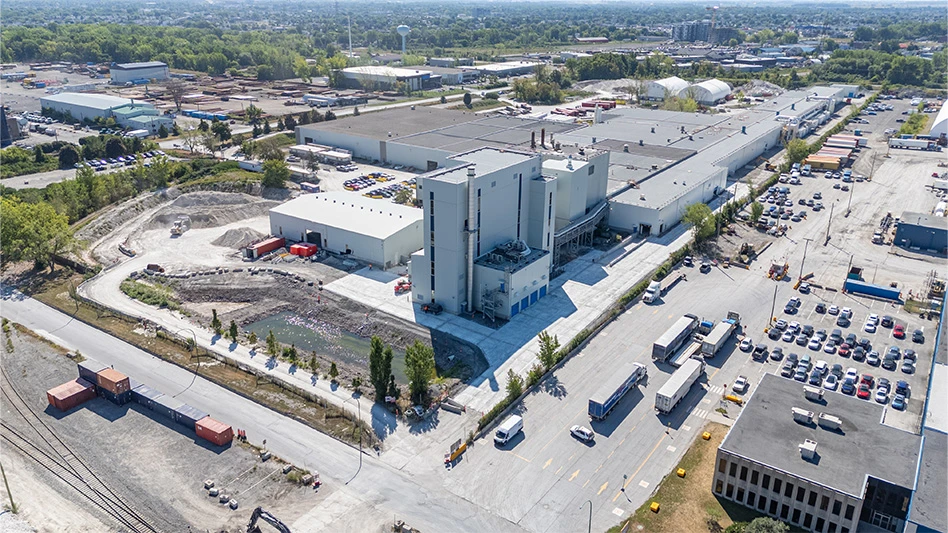
Photo courtesy of Saint-Gobain Canada
Montreal-based Saint-Gobain Canada has completed an expansion and sustainable upgrade project at its Sainte-Catherine, Quebec, CertainTeed Gypsum plant. The project completion makes the facility the first Scopes 1 and 2 zero-carbon gypsum wallboard plant in North America and the largest of its kind in the world, according to the company.
In 2022, Saint-Gobain completed electrification upgrades enabling the plant to be powered solely by renewable electricity. Over the course of three years, approximately 80 percent of the plant’s equipment was upgraded, and new processes were implemented to reduce carbon emissions. Key upgrades include:
- adding process sensors;
- improving compressed air design;
- implementing real-time smart energy meters and management system;
- implementing multiple heat recovery systems and upgrading equipment insulation; and
- replacing natural gas burners with electrical heating elements.
“The ambitious electrification project we just completed in Canada is a tangible and impactful example of Saint-Gobain's commitment to truly ‘Making the World a Better Home,’” says Jean-Claude Lasserre, CEO of Saint-Gobain Canada. “We were also able to increase production capacity to help address one of Canada’s most pressing current challenges: addressing the housing shortage. This impressive feat shows that with commitment and determination, both productivity and sustainability can walk hand in hand to better the future for all Canadians.”
In addition to the plant upgrades, Saint-Gobain has launched a new Infinaé gypsum wallboard category in Canada, a low-climate-impact range of gypsum solutions. The facility upgrades have helped to decrease energy usage by up to 30 percent and boosted production capacity by 40 percent, Saint-Gobain says. To date, the new processes and equipment have reduced the CertainTeed’s plants CO2 emissions by approximately 88 million pounds, or 44,000 tons.
“[The] ribbon cutting ceremony marks several years of hard work and dedication to build a sustainable and net-zero (Scopes 1 and 2) plant that will be an example for the entire manufacturing industry,” says Mark Rayfield, president and CEO of Saint-Gobain North America. “This important investment will not only make Saint-Gobain North America the leader in sustainable drywall manufacturing; it will further our operations in Canada, where we remain committed to growth and providing light and sustainable building materials for all Canadians.”
The Sainte-Catherine plant project was granted $40 million in partnership with Quebec’s Ministry of the Environment, the Fight Against Climate Change, Wildlife and Parks and Hydro-Québec.
“Saint-Gobain shares our government’s commitment to accelerate the energy transition and decarbonize our economy,” says Christine Fréchette, member of the National Assembly for Sanguinet and minister of economy, innovation and energy. “Establishing its zero-carbon gypsum wallboard plant is a great example of this, and we are extremely proud to see this important project come to fruition here, in the riding of Sanguinet.”
“Hydro-Québec is proud to have contributed to the creation of the first zero-carbon gypsum wallboard plant in North America, an inspiring model for the entire industry,” says Caroline DeVit, senior director of business development and performance at Hydro-Québec. “CertainTeed is exemplary not only in terms of energy efficiency, with a 30 percent reduction in its consumption, but also in its efforts to help reduce consumption during peak periods. To achieve Quebec's energy transition, decarbonization must be done efficiently, and this project is a concrete example of that. From the ideation phase, our experts collaborated with CertainTeed to transform an innovative vision into a sustainable and high-performing reality.”
Saint-Gobain says additional improvements are being implemented and will be deployed soon. These include increasing recycled content by using pre- and postconsumer waste and reducing inbound transportation of natural gypsum rock—both part of the company’s goal of reaching net zero carbon by 2050.
Latest from Construction & Demolition Recycling
- Sybilion seeks to help manufacturers confidently address volatility
- Construction backlog rebounds in February
- USTR to study additional steel, aluminum tariffs
- Shawmut commemorates National Women in Construction Week
- Holcim expands presence in Colombia with agreement to acquire Cemex operations
- eFactor3 enters into separation tech partnership
- Mitsubishi Logisnext Americas to rebrand as Logisnext Americas
- Burns Services diverts more than 1.2M tons of C&D materials from landfills