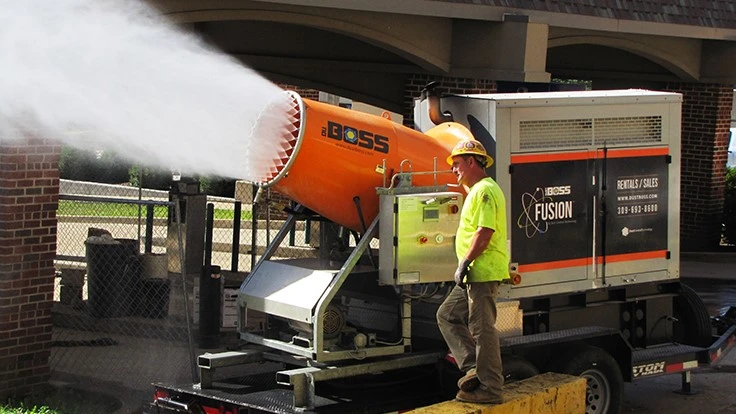
 BossTek, a manufacturer of dust control equipment headquartered in Peoria, Illinois, says its equipment was recently used by a demolition firm to contain dust emissions during the teardown of a 5-story concrete parking deck in a densely populated area.
River City Demolition, Peoria, Illinois, used a self-contained and mobile DustBoss DB-60 Fusion manufactured by BossTek to suppress airborne dust created by the jaw processor and falling debris. BossTek says using the DustBoss reduced the need for manned hoses and maintained the air quality needed to comply with regulations.
From the outset, the planners realized that the downtown location of the parking deck would require dust control beyond manual spraying with a fire hose. “With occupied buildings on two sides and city streets on the other two, we wanted to find the best method available to suppress the demolition dust and prevent its migration,” Josh Runyon, River City operator and estimator, says. “We knew our water trucks could help control surface dust on the ground, but our big concern was finding a way to address airborne dust, something that could knock down particles and keep them on-site.”
Because of the close-in location and confined space, River City crews decided to use a jaw processor to pulverize the concrete and take the parking decks down a section at a time, which helped avoid dust clouds from large sections falling at once, but BossTek says Runyon stressed the need for containment when he spoke to Sales Manager Mike Lewis.
“When Josh called us, we had a DustBoss DB-60 Fusion on hand, which is one of our larger designs that’s equipped with its own generator for locations without convenient access to power,” Lewis says.
The water source for the DustBoss was a municipal hydrant located nearby, fed by a standard 2-inch hose. The DB-60 Fusion forces water through a circular stainless steel manifold with 30 atomizing spray nozzles, then launches the droplets with a 25 horsepower fan designed to produce 30,000 cubic feet per minute of air flow. Atomized mist droplets of 50 to 200 microns are thrown out in a 200-foot cone at an adjustable zero to 50-degree elevation angle. The DB-60 uses around 23 gallons per minute of water.
The single atomized misting unit is designed to deliver 62,800 square feet of coverage. The unit was paired with a 45-kilowatt generator set featuring a John Deere Tier III Flex engine with a 100-gallon fuel tank, designed for up to 24 hours of runtime.
At 80 inches wide, the system can be placed anywhere dust suppression is needed and adjusted based on changes in wind or work activity. The optional dosing pump is powered from the standard 120-volt electrical outlet on the generator set.
Water sources can vary, BossTek says, and the unit requires a constant supply pressure of 10 pounds per square inch. The water is delivered to the atomized misting unit through a hose with a cam-and-groove quick disconnect coupling leading to the booster pump. BossTek says the pump adds approximately 150 pounds per square inch, with a maximum of 250 pounds per square inch, depending on the inlet pressure. For use with a nonpotable water source, the Fusion can be equipped with filter options.
Runyon’s suspicions of the project’s dust emissions proved correct. “It was one of the dustiest projects I’ve ever worked on,” he says. “But the DustBoss did a great job. We could locate and aim it perfectly each day, and neighbors seemed pleased with the dust management. In fact, we didn’t receive a single dust-related complaint during the entire two and a half months on the job.”