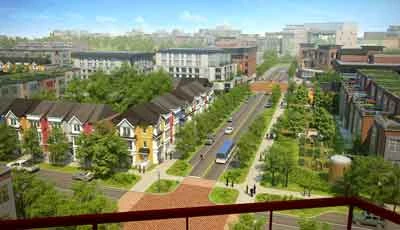
It has been just over one year since the last airplane took flight from the former City Centre Airport in Edmonton, Alberta, to make way for building what is being considered one of the largest sustainable developments in the world. Since this last flight, the city of Edmonton, Alberta, has begun construction at Blatchford with a focus on reducing the environmental impact during the first stage of development.
“We are building Blatchford to be a leader in environmentally friendly community design and to serve as a model for sustainable communities around the world,” says Mark Hall, executive director, Blatchford Redevelopment. “This commitment to reducing Blatchford’s environmental footprint has to start at the very first stage of construction. To maintain responsible environmental development over the course of the construction we are essentially finding ways to recycle an airport.”
The recycling and reuse initiatives happening on site include:
“We are building Blatchford to be a leader in environmentally friendly community design and to serve as a model for sustainable communities around the world,” says Mark Hall, executive director, Blatchford Redevelopment. “This commitment to reducing Blatchford’s environmental footprint has to start at the very first stage of construction. To maintain responsible environmental development over the course of the construction we are essentially finding ways to recycle an airport.”
The recycling and reuse initiatives happening on site include:
- Buildings—The former airport hangars are being deconstructed instead of demolished. Through the deconstruction process, a building is slowly dismantled to allow the building materials to be sorted for recycling, reuse or waste management. This differs from standard demolition, where the building is taken down as fast as possible with the materials likely ending up in a landfill. A minimum of 85 percent of the waste created from the buildings in Blatchford will be diverted from the landfill.
- Runways—All runways will be removed and recycled on site. The materials (concrete, asphalt and gravel) will be used to construct the roads in the community. Any excess materials will be sold for reuse elsewhere.
- Stormwater Ponds—Rather than hauling the earth that is dug up to create the stormwater ponds off site, the soil will be used to build a large hill in the community. For the first stormwater pond, this means reducing the environmental impact associated with trucking 250,000-300,000 cubic meters of soil out of the community.
In addition to the recycling and reuse initiatives happening during construction, the city is still investigating the feasibility of a district energy system to significantly reduce greenhouse gas emissions in the community. If feasible, the system could provide heating and cooling for all buildings in Blatchford using 100 percent renewable energy.
Blatchford will be home for up to 30,000 residents when the development is complete.
Blatchford will be home for up to 30,000 residents when the development is complete.
Latest from Construction & Demolition Recycling
- ALLU offers new crusher bucket
- Waste Pro files brief supporting pause of FMCSA CDL eligibility rule
- Des Moines project utilizes recycled wind turbine blades
- Vecoplan to present modular solutions at IFAT 2026
- Terex Ecotec appoints Bradley Equipment as Texas distributor
- Greenwave raises revenue but loses money in Q2 2025
- Recycled steel prices hold steady
- John Deere launches ‘Building America’ excavator contest