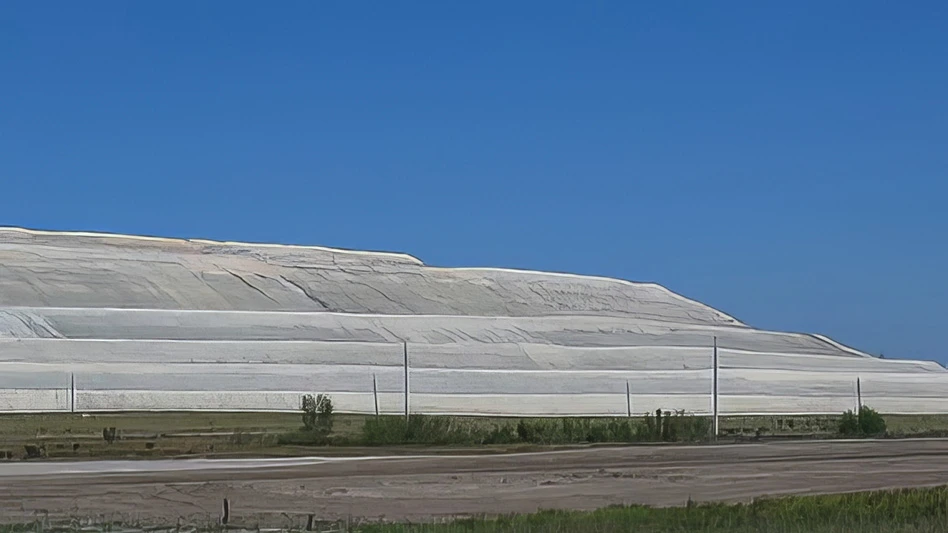
Photo courtesy of the Environmental Protection Agency
In Florida, a controversy has developed over the potential use of phosphogypsum (PG) in highway construction work.
The Florida House of Representatives is considering HB 1191 while the state senate is considering a sister bill, SB 1258. The bills, if passed, would require the Florida Department of Transportation to conduct “a study to evaluate the suitability of PG as a construction aggregate material” in road work.
PG, a byproduct of phosphate rock processed in fertilizer production, according to sciencedirect.com, is difficult to use in several applications because of its radioactivity. Some environmental groups have opposed its use in road work because of its danger to the environment and construction workers.
“This would be an outrageous handout to the phosphate industry at the expense of the health and safety of Floridians and our environment,” says Ragan Whitlock, an attorney at the Tucson, Arizona-based Center for Biological Diversity. “If this bill becomes law, Florida roads would become ticking time bombs, waiting for the next storm event to expose our communities and waterways to this radioactive waste.”
PG is permitted for use in roads in Canada and countries in South America, Asia, Europe and Africa, according to a statement penned by Christopher Glen, the director of advocacy and public relations at The Fertilizer Institute, Arlington, Virginia.
Glen’s statement was in response to a 2021 decision by the Environmental Protection Agency (EPA) to withdraw its October 2020 decision to allow PG in road work. The International Atomic Energy Agency (IAEA) states PG can be repurposed beneficially at low radiation levels in road construction and other uses, such as additives for concrete and cement.
The alternative to recycling or reusing PG is stacking it, creating formations similar to landfills with radioactivity as a primary environmental concern, according to the IAEA.
“In the United States, the cost of remediating the unlined Piney Point Stack in Florida … is estimated to date to have been of the order of $300 million,” says the IAEA in The "constructive regulation" of phosphates and phosphogypsum. “This has caused the Florida legislature to require a $150 million bond or balance sheet appropriation to be made even for new … lined stacks.”
A summary of SB 1258 cites the Florida Industrial and Phosphate Research Institute as saying there are 1 billion tons of PG already stacked in 24 locations across the state and an additional 30 million tons generated annually.
However, the Center for Biological Diversity argues that PG should not be used in roads because of the tendency of roads to break down in storms, causing runoff of dangerous chemicals.
“Last September, Hurricane Ian left a path of destruction across southwest Florida, demolishing roads and collapsing bridges along its path,” the Center for Biological Diversity says. “The destruction highlighted the danger of proposals to use toxic, radioactive phosphogypsum waste in road construction, which could be unearthed and expose communities and the environment to harm. As climate change drives storms of increasing intensity, Florida faces escalating risks of similar destruction in the future.”
Some of the elements contained in PG that concern the Center for Biological Diversity include Radium-226, which it says has a 1,600-year radioactive decay half-life; various carcinogens; and heavy metals such as antimony, arsenic, barium, cadmium, chromium, copper, fluoride, lead, mercury, nickel, silver, sulfur, thallium and zinc.
Latest from Construction & Demolition Recycling
- ABC names 2026 top-performing construction companies
- Recology demonstrates composting techniques
- Superior adds conveyor dust control features
- MB Crusher at ConExpo
- Reclaiming rebar from concrete with use of a self-cleaning suspended overhead magnet
- Suspended magnet options galore
- European Demolition Association selects Dublin for annual convention
- Are you missing out on money?