The veteran chief economist of the Portland Cement Association (PCA), Skokie, Ill., has expressed concern that the sub-prime mortgage crisis is about to ripple into other segments of the economy.
In a late October Webcast entitled “Cement Outlook: 2008,” Ed Sullivan acknowledged the inexact nature of economic forecasting, remarking that he had recently been on a panel with four other economists who each had differing outlooks for 2008. Sullivan said it made him think of the old axiom, “Put five economists in a room and you’re going to get six different opinions.”
Sullivan’s own forecast for 2008 includes different scenarios hinging on different variables, but his underlying concern regarding the
The crux of the problem, according to Sullivan, is that “the sub-prime issue is not something that has just showed up or is just going to disappear.”
The lending crisis has dramatically slowed the residential construction segment and has contributed to an inventory of unsold homes that is double what real estate industry analysts consider healthy.
Sullivan noted that a 10-month supply of homes is listed for sale right now, double the more typical 5-month supply. Thus, some 2 million homes on the market “must be burned off before recovery sets in” on the residential side of the market, according to Sullivan.
More alarming is the possibility that the crisis is affecting other sectors of the economy, including non-residential construction and consumer spending.
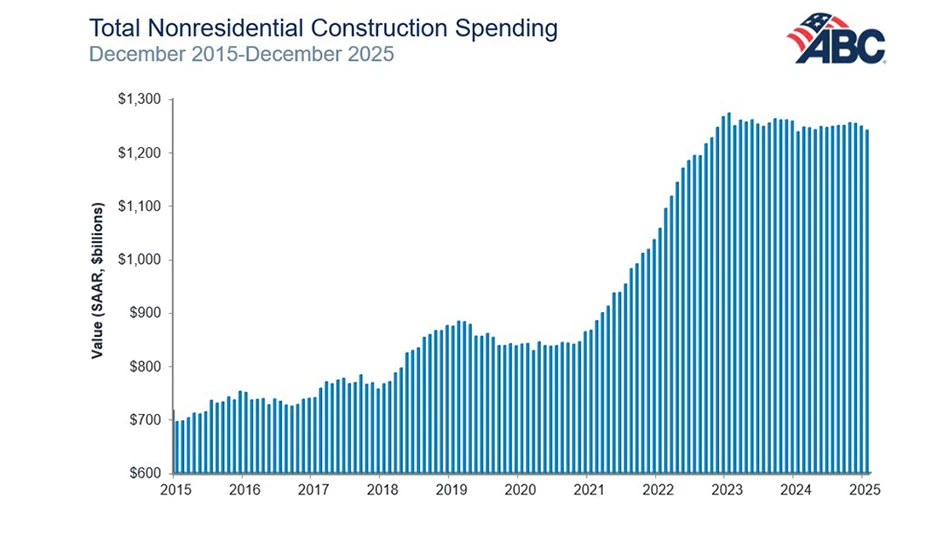
In 2007, increased non-residential construction has been helping offset the residential construction decline for companies and workers in the building trades. In 2008, “that’s no longer the case,” predicts Sullivan. “We see a modest decline.”
And in another ripple beyond that, if an economic slowdown affects state and local tax receipts, then the third construction segment—public infrastructure spending—could also feel the pinch. Sullivan said tax receipts will slow down and federal government help will be unlikely. “Revenue will slow down fast and at the same time, you’ll still have a growing and larger deficit. In that situation, I don’t see how government can step in and spend more,” he stated.
Beyond construction industry woes, if credit tightens at the same time that the labor market becomes soft (keeping a lid on wages) and energy costs rise, then consumer spending—which accounts for two-thirds of the United States economy—will falter, possibly setting the scene for recession in 2008 and 2009.
Sullivan said that in one of his scenarios, if Fed interest rate policy helps spur modest activity, then slow GDP growth of 1.9 percent is possible in 2008.
In another scenario, the Fed could miscalculate that the economy is healthy based on 2007 holiday season credit card expenditures. “Then comes the first quarter of 2008, and credit card bills come due and high energy costs come due and then suddenly you have a dramatic retrenchment in consumer spending,” Sullivan warned.
If the Fed acts belatedly to enact lower interest rates in this scenario, “GDP declines 1 percent in 2008,” predicted Sullivan. A gradual recovery does not occur until 2010 and 2011 in this PCA scenario.
Latest from Construction & Demolition Recycling
- Des Moines project utilizes recycled wind turbine blades
- Vecoplan to present modular solutions at IFAT 2026
- Terex Ecotec appoints Bradley Equipment as Texas distributor
- Greenwave raises revenue but loses money in Q2 2025
- Recycled steel prices hold steady
- John Deere launches ‘Building America’ excavator contest
- Triumvirate Environmental acquires Environmental Waste Minimization
- Coastal Waste & Recycling expands recycling operations with Machinex