Photo by Clemens Richter and courtesy of System 180 GmbH
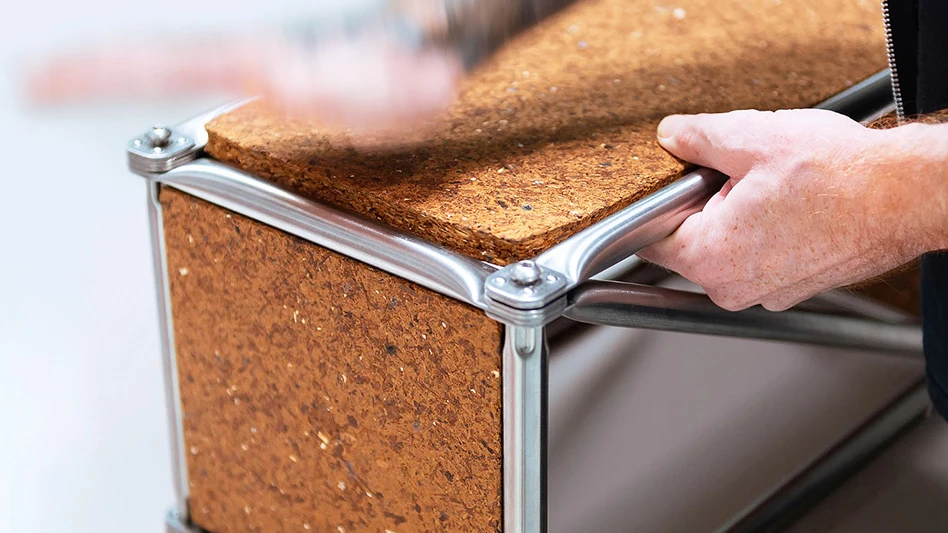
A research organization called the Fraunhofer Institute for Applied Polymer Research (IAP) says it has developed a process that can produce 100 percent-recycled-content particleboard, also known as chipboard.
The Germany-based Fraunhofer IAP has developed its process in collaboration with the Eberswalde University for Sustainable Development (HNEE) of Germany; System 180 GmbH, a furniture producer based in Berlin; and recycled materials processor PreZero Holz GmbH, also based in Germany.
The research project was funded by the Agency for Renewable Resources (FNR) through the German Federal Ministry of Food, Agriculture and Home Affairs BMLEH.
The research organization says particleboard is widespread in the European construction and furniture industries, but notes that until now, its life cycle usually ended with incineration.
The new project involved the partners developing a chemical recycling process that enables 100 percent reuse of wood-based panels without the need to blend in either new wood chips or adhesives.
Mathias Köhler of Fraunhofer IAP, who coordinated the effort, says a comprehensive material recycling concept for wood-based panels was tested for the project, called Recycling of Wood-Based Particleboards (ReSpan).
“We take wood from used furniture or building components, shred it, treat it in a novel process with a specially developed recycling agent, and press it into new, dimensionally stable boards,” Köhler says.
“What makes it special is that the originally used resin adhesive is partially dissolved and specifically reactivated by the agent. About 95 percent of the recycling agent can be recovered and reused multiple times without losing effectiveness.”
The researcher says the chemical process has been successfully scaled up at Fraunhofer IAP‘s synthesis pilot plant at a Fraunhofer facility in Schkopau, Germany.
Converting the processed chipboard scrap into new particleboard can be carried out using what Fraunhofer IAP calls conventional equipment. For the project, recycling firm PreZero Holz analyzed sorting strategies for scrap wood and evaluated the economic feasibility of the process.
Furniture producer System 180 expresses support for the recycling method.
“For us as a manufacturer of customized furniture solutions, the process opens up new ways to combine sustainable design with functional quality,” says Francesco Coccia, the firm’s head of marketing. “The use of material boards made from recycled wood could be an ecological as well as aesthetic advantage in the future."
To transfer and further develop the process for industrial applications, the consortium says it is seeking new project partners.
“We particularly invite sorters and recyclers, as well as manufacturers of resins, wood-based panels, or furniture, to participate,” Köhler says.
Fraunhofer IAP says the project fits in with its wider mission.
“What was once considered residual material can now become a valuable raw material for industrial processing, all without virgin material,” Köhler says.
“If waste wood can be kept in the material cycle, the demand for fresh wood can be significantly reduced, making a real contribution to resource conservation," adds Andreas Schütte, managing director of the FNR agency. "The project demonstrates how such material cycles can be established in the construction sector—a goal we are consistently pursuing with [our] timber construction and circular economy strategy.”
Latest from Construction & Demolition Recycling
- Sybilion seeks to help manufacturers confidently address volatility
- Construction backlog rebounds in February
- USTR to study additional steel, aluminum tariffs
- Shawmut commemorates National Women in Construction Week
- Holcim expands presence in Colombia with agreement to acquire Cemex operations
- eFactor3 enters into separation tech partnership
- Mitsubishi Logisnext Americas to rebrand as Logisnext Americas
- Burns Services diverts more than 1.2M tons of C&D materials from landfills