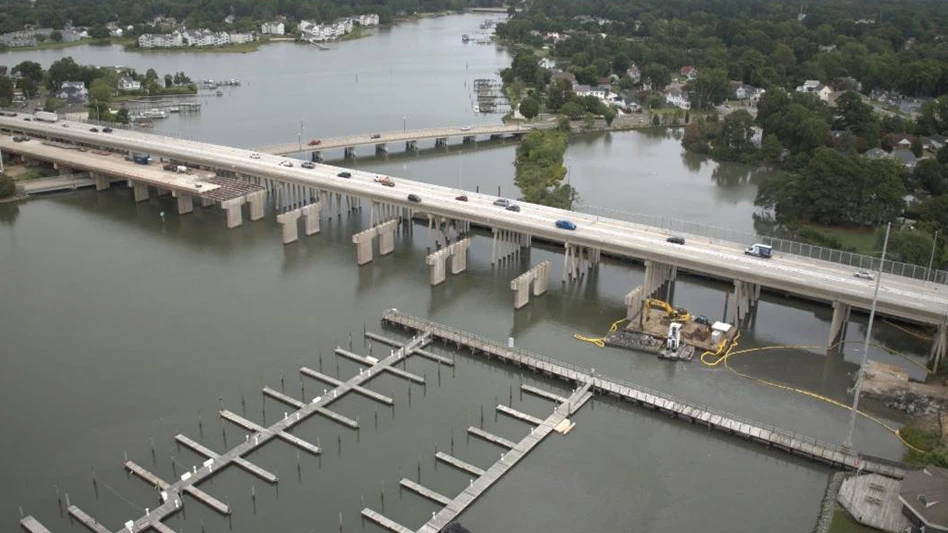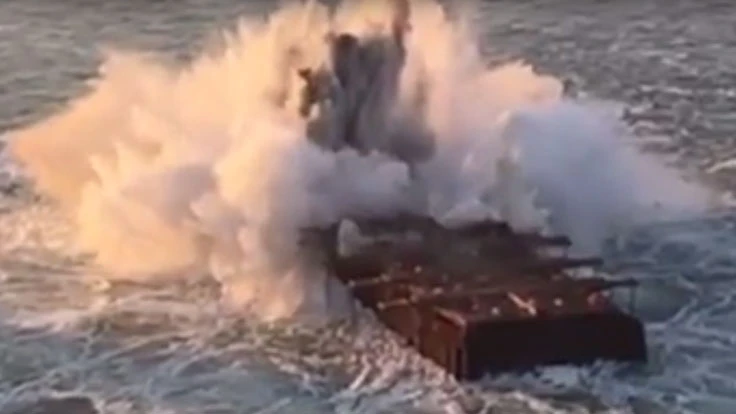
The largest of the piers of the San Francisco-Oakland Bay Bridge’s old east span was removed from the Bay through a careful and extensively planned implosion in the early morning hours of Nov. 14.
At slack tide, years of preparation, more than half-a-dozen permits, and thousands of hours of labor culminated in what appears to be a successful implosion, according to a California Department of Transportation press release. In just six seconds, nearly 600 controlled charges weakened the 50-feet of Pier E3 which stood above the bay floor, allowing gravity to collapse the tower into its hallow casing below the mudline. Click here to watch a video of the implosion.
“In the coming weeks, we’ll be exhaustively collecting extensive data and determining the effect the implosion had on the environment and fish nearby,” says Brian Maroney, chief bridge engineer of Caltrans’ Toll Bridge Program. “We don’t know exactly what it looks like down there, not yet. The information will be critical for determining the best method for demolishing the remaining 21 piers.”
While there is much still to be analyzed, a number of goals were met today by Caltrans, its contractors, and participating and permitting agencies:
- The implosion occurred during the target month of November, the month with the least environmental impact, including the fewest marine animals present.
- The blast attenuation system, or “bubble curtain,” which is estimated to cut down the pressure waves from the charges by about 80 percent was successfully deployed.
- Dozens of environmental and biological experts carefully monitored areas surrounding the blast zone, verifying large animals were not nearby during the implosion.
- The brief traffic stop on the Bay Bridge and BART trains in the Transbay Tube protected the public from distraction. The stop is now lifted.
- The only remaining visible evidence of the event was a floating timber that sat atop the pier, and the slowly progressing dust cloud, which was visible from above for a couple of hours. It was being carefully monitored by deployed experts.
Caltrans says in the coming weeks updates will be available on the following items:
- Three dimensional imaging of what it looks like on the bay floor. This data is pivotal to assessing the effectiveness of the implosion, and how much, if any, debris needs to be picked up from outside the remainder of Pier E3, and placed inside the hollow structure.
- The effect of the implosion forces on fish and wildlife.
- The composition of the dust cloud created by the implosion.
- If the traffic and BART stops will be necessary for future potential implosions.
Eight different public agencies permitted the implosion of Pier E3. Their input and assistance was crucial. Data collected over the next several months will be compiled into a report to assist in determining if Caltrans will seek additional approvals to implode some or all of the remaining 21 piers from the old east span.
Additional information can be found at http://dot.ca.gov/e3implosion.
Latest from Construction & Demolition Recycling
- Greenwave raises revenue but loses money in Q2 2025
- Recycled steel prices hold steady
- John Deere launches ‘Building America’ excavator contest
- Triumvirate Environmental acquires Environmental Waste Minimization
- Coastal Waste & Recycling expands recycling operations with Machinex
- Reconomy acquires German-based GfAW
- CommanderAI launches HaulerCentral database
- Glass Recycling Foundation releases 2025 Impact Report