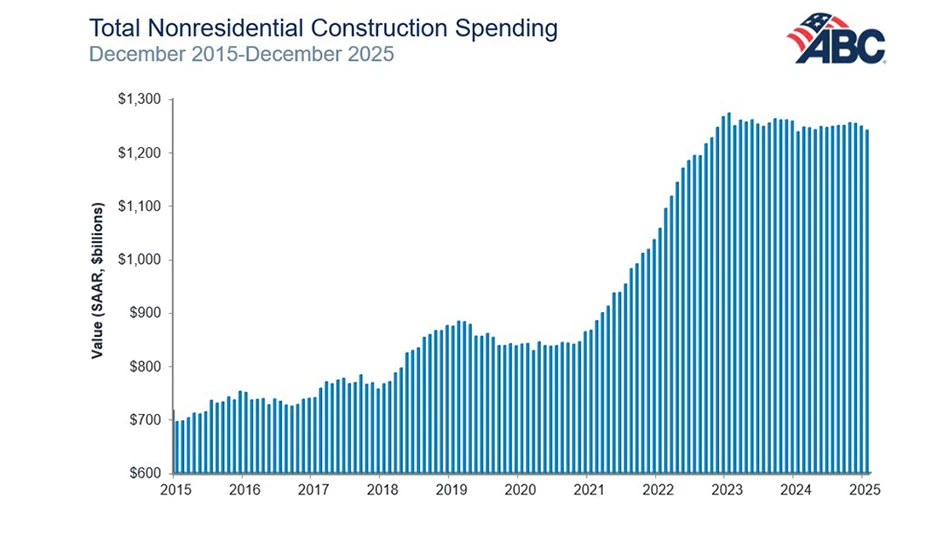
According to a recent Associated Builders and Contractors (ABC) analysis of U.S. Census Bureau data, national nonresidential construction spending rose 0.3 percent in April, totaling $792.6 billion on a seasonally adjusted annualized basis, which is a 6.4 percent increase compared to the same time last year.
While public nonresidential spending expanded 4.8 percent on a monthly basis and increased 15.4 percent since April 2018, private nonresidential spending fell 2.9 percent in April and is up just 0.6 percent year-over-year, ABC says.
Among the 16 nonresidential construction spending categories, nine experienced an increase in monthly spending, with the largest increases registered in water supply (9.8 percent), highway and street (6.8 percent) and transportation (3.9 percent). Manufacturing (-7.1 percent) and commercial (-3.7 percent) experienced the largest decreases in April, though manufacturing spending is still up 10.9 percent compared to the same time last year.
“Today’s data release shows that nonresidential construction spending remains vigorous in America,” says ABC Chief Economist Anirban Basu. “While April’s monthly nonresidential construction spending growth of 0.3 percent appears lackluster, this was largely the result of a sizeable upward revision to March construction spending figures.
“Today’s data release also indicates that the baton has now been fully passed,” Basu says. “Earlier in the recovery, nonresidential construction spending growth was primarily driven by private segments. Low interest rates and abundant liquidity helped fuel private investment in hotels, data centers, casinos, fulfillment centers and other forms of private construction. But over the past year, private nonresidential construction spending has barely budged. Meanwhile, public residential spending is up 15.4 percent, and April’s spending growth was led by water supply and highway/street.
“Given current levels of backlog, which expanded to 9.5 months in March 2019, nonresidential construction spending should remain elevated,” Basu says. “That said, risks of recession in 2020 are rapidly rising, which has the potential to reduce construction activity in 2021 and/or 2022.”Latest from Construction & Demolition Recycling
- Terex Ecotec appoints Bradley Equipment as Texas distributor
- Greenwave raises revenue but loses money in Q2 2025
- Recycled steel prices hold steady
- John Deere launches ‘Building America’ excavator contest
- Triumvirate Environmental acquires Environmental Waste Minimization
- Coastal Waste & Recycling expands recycling operations with Machinex
- Reconomy acquires German-based GfAW
- CommanderAI launches HaulerCentral database