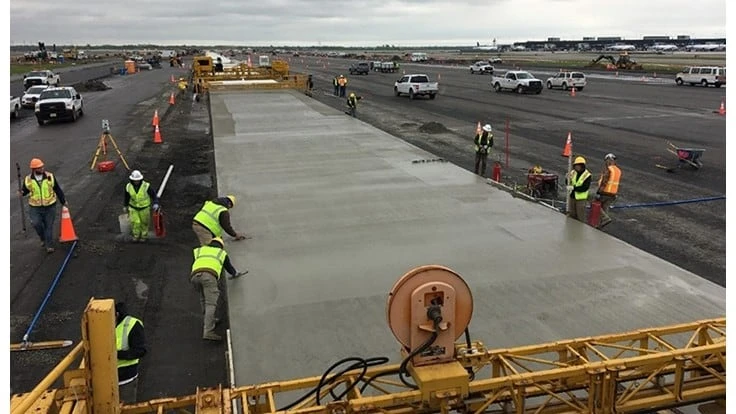
Photo provided by te Port Authority of New York and New Jersey.
The Port Authority of New York and New Jersey (PANYNJ) says it is taking concrete steps to reduce emissions through its construction practices – literally. As part of its Clean Construction Program, launched last year, the agency is working with nearby universities to test more sustainable concrete mixes, including some with recycled materials.
PANYNJ says it will be working with Rutgers University and New York University (NYU) to develop and test new low-carbon concrete mixes. “The Low Carbon Concrete Program advances the Port Authority’s already strong commitment to sustainable building and greenhouse gas reduction,” says Christine Weydig, director of the Office of Environmental and Energy Programs at the agency.
“Accelerating climate action depends on scaling low-carbon technologies and programs like these can help commercialize the materials we need to grow and build sustainably,” she adds. “We are committed to sharing our results widely.”
Port Authority Chief Engineer Jim Starace says the Low Carbon Concrete Program already mandates the substitution of cement with residual products from other industries, such as slag from steel production. Additionally, the agency says it has developed a carbon management application to track data on the environmental impacts of construction materials.
“We’ve proven that we can reduce emissions without sacrificing performance,” Starace said. “The next step is to work with our academic partners and industry to continue improving the production of low emissions, high-performing concrete mixes.”
Port Authority staff along with academic staff from Rutgers and NYU will focus on maintaining quality and performance and, potentially, lowering costs, in the new mixes they develop, says Starace. Currently, field testing is planned for John F. Kennedy Airport during future phases of its redevelopment.
“The Low Carbon Concrete Program will be an essential piece of our airport redevelopment projects as we continue to build for the 21st century,” says Hersh Parekh, director of government and community relations for New York Aviation Redevelopment. “By adopting global best practices in sustainability at our world-renowned airports, we are helping the industry prepare for the future, reducing the environmental impact of our capital construction projects on surrounding communities, and doing our part to combat the existential threat of climate change.”
Latest from Construction & Demolition Recycling
- Vermeer announces plan to build new facility in Des Moines metro area
- Capstar Disposal expands roll off dumpster rental services
- Supreme Court strikes down IEEPA tariffs
- Casella details facility closures, expansion efforts
- DPR Construction cuts ribbon on Silicon Valley office, prefab facility
- Constellium posts record Q4 adjusted EBITDA
- Amrize closes PB Materials acquisition
- QCC torches include customizable features