Demolition contractors and their subcontractors who recycle materials are having increasing problems dealing with municipal franchising laws, especially in South Florida. The issue was one of several facing construction and demolition (C&D) materials recyclers cited at a session that took place during the National Association of Demolition Contractors (NADC) in Orlando, Fla., in early April.
NADC guest speaker Timothy Townsend, a researcher at the University of Florida who has worked on several projects focusing on C&D materials recycling, noted that “exclusive franchise agreements” have hampered C&D recycling efforts in Florida, and attendees were quick to agree.
Several demolition contractors and recyclers in attendance said they are facing container placement fees in the $50 range in cities such as Orlando and Fort Myers, Fla.
Townsend noted that one Florida legislator introduced Senate Bill 1462 last year, which would have defined recovered C&D materials as a separate product category exempt from solid waste franchising regulations. But he remarked that efforts to pass the bill have stalled and it does not seem likely to move forward any time soon.
Rigid franchising agreements have been seen in other parts of the country as well, including California and Washington State.
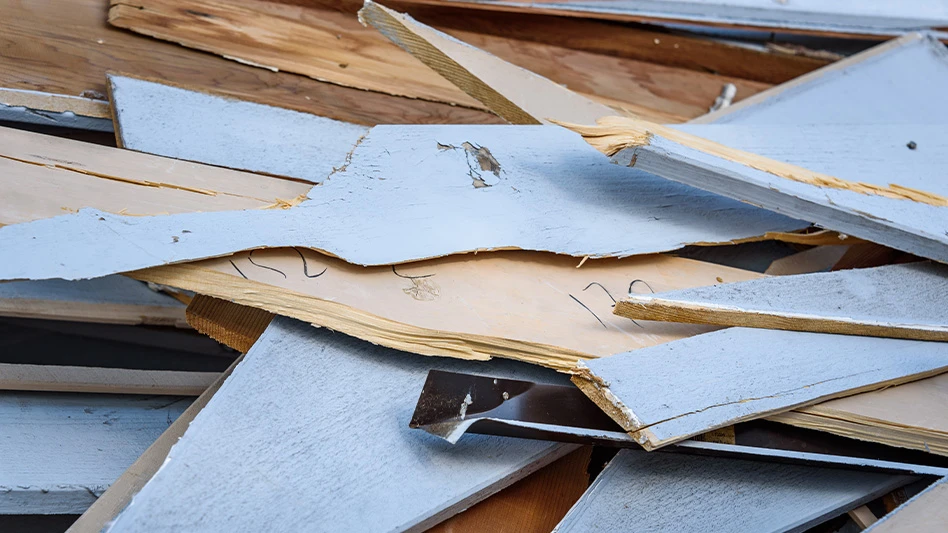
Other issues facing C&D recyclers include coping with the presence of lead-based paint (LBP) and lumber treated with chromium copper arsenate (CCA) in the recycling stream.
Regulators and health officials remain vigilant in terms of carefully monitoring the handling of lead in any form, including as paint in the C&D concrete and wood stream. Concerns about toxic levels of arsenic found in CCA-treated wood are more recent.
Concrete recyclers are maintaining that LBP within the concrete stream is found in such small amounts as to be negligible in any given load of crushed concrete. “It would be very difficult for concrete to be considered a hazard because of a coat of lead-based paint,” said Townsend.
Recyclers of scrap wood, however, will have to remain vigilant in how they handle older painted wood as well as decking, stairs and other pieces of lumber that were treated with CCA. He noted that wood fuel users have their emissions monitored for lead and arsenic, so material will have to meet set standards of non-contamination. There are also concerns in the mulch market that CCA-treated wood be kept out of that stream, since mulch is handled by bare hands and used as playground cover.
The NADC Annual Convention took place at the Renaissance Orlando resort March 30 to April 2.
Latest from Construction & Demolition Recycling
- Vecoplan to present modular solutions at IFAT 2026
- Terex Ecotec appoints Bradley Equipment as Texas distributor
- Greenwave raises revenue but loses money in Q2 2025
- Recycled steel prices hold steady
- John Deere launches ‘Building America’ excavator contest
- Triumvirate Environmental acquires Environmental Waste Minimization
- Coastal Waste & Recycling expands recycling operations with Machinex
- Reconomy acquires German-based GfAW