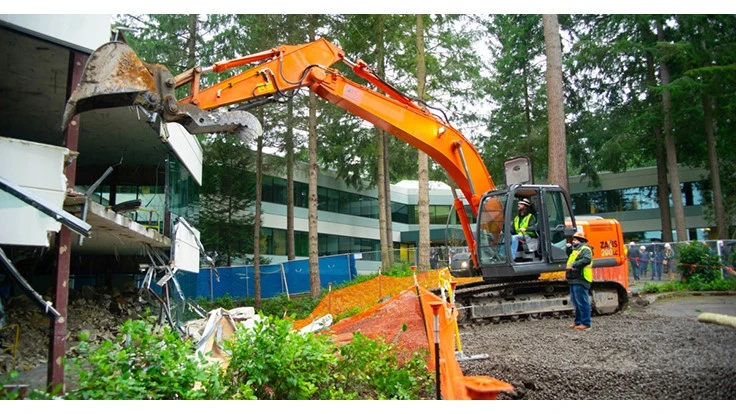
Microsoft began demolition of buildings on its campus in Redmond, Washington, on Jan. 8, marking a major step in its campus modernization effort due to wrap up in 2022.
Over the next few months, Microsoft will be decommissioning and demolishing 13 buildings to make way for 18 new buildings across four villages to create a unified campus. When the project is finished, Microsoft says in a blog post that the new campus will provide a modern workplace and create greater collaboration and community.
To commemorate the original buildings, Microsoft says it offered an exclusive opportunity for a group of employees to say goodbye to the original campus with a demolition party to kick off the destruction. The day deconstruction began, ten Microsoft employees who collectively donated money to charity to win the experience via the Employee Giving Campaign auction began demolishing the company’s first buildings with sledgehammers and an excavator.
“It is great to see the interest and excitement from employees for the campus modernization,” says Michael Ford, Microsoft general manager of global real estate and security, in the blog post. “Our employees are crucial to building an exceptional place to work, and this event was a great way to kick off this journey together.”
Over the next few months, Microsoft says it will embrace sustainable practices throughout its deconstruction.
In 2016, Microsoft says it became the first technology company in the U.S. to be certified Zero Waste for diverting at least 90 percent of its waste from the landfill. Microsoft says its goal with this project is to remain in line with this certification for construction materials and divert a majority of building materials from the landfill. Microsoft says most of the materials recovered in the process – like concrete, steel framing, carpets, ceiling tiles, electronic and networking gear, interior debris, furniture and artificial turf – will find a new life elsewhere.
“We strive to make a positive impact on the community,” Ford says. “We’re putting a lot of effort behind finding innovative ways to reduce our impact and optimize our resource usage.”
Beyond what is being recycled, the company is also considering where materials will be processed. To maximize sustainability, Microsoft says its construction team is engaging with local waste processing and recycling companies to study and prioritize the hauling distances to further shrink the project’s construction carbon footprint.
“Corporate and environmental responsibility are equally as important as budget and schedule — and we are aligning our design and construction practices with Microsoft’s global corporate responsibility and sustainability missions,” Ford says. “It feels good to know that here in our hometown we’re supporting this vision.”
Follow updates and developments as the project progresses on Microsoft’s Modern Campus site.
Latest from Construction & Demolition Recycling
- ALLU offers new crusher bucket
- Waste Pro files brief supporting pause of FMCSA CDL eligibility rule
- Des Moines project utilizes recycled wind turbine blades
- Vecoplan to present modular solutions at IFAT 2026
- Terex Ecotec appoints Bradley Equipment as Texas distributor
- Greenwave raises revenue but loses money in Q2 2025
- Recycled steel prices hold steady
- John Deere launches ‘Building America’ excavator contest