Image courtesy of Light House
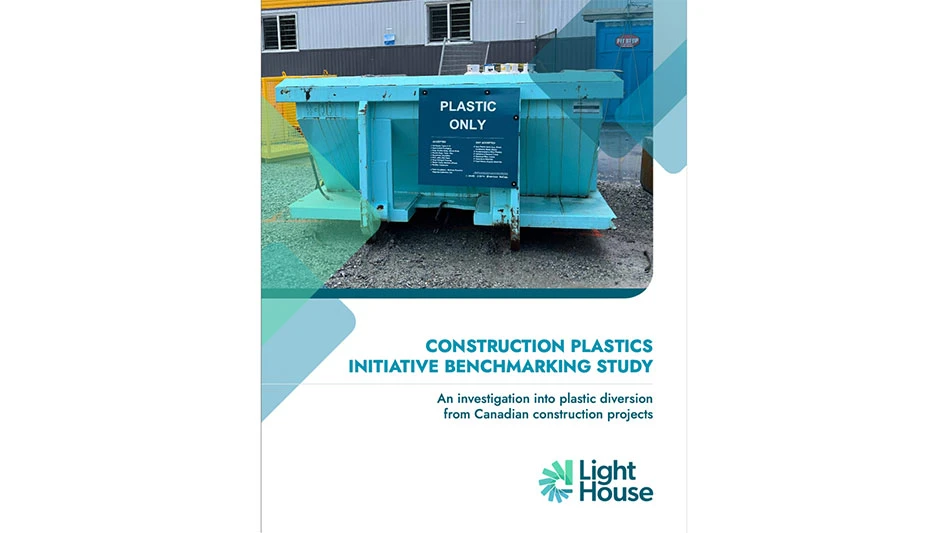
Vancouver-based project and environmental services firm Light House has released information culled from the results of its Construction Plastics Initiative (CPI) Benchmarking Study, which it calls the first large-scale national effort to evaluate plastics in Canadian construction projects.
Light House says the study has found gaps, opportunities and a pathway to a circular economy for construction plastics, providing a baseline as Canada’s construction sector prepares for expanded plastics reporting.
The study is based on an analysis of diversion data from 253 Leadership in Energy and Environmental Design- (LEED-) certified green building projects that took place in seven Canadian provinces over a span of several years.
The study demonstrates that construction plastics remain under-tracked and under-managed at jobsites, according to Light House, prompting it to set out recommendations to close such gaps through stronger reporting, supplier engagement and on-site practices.
“While single-use plastics have long been in the spotlight by industry and policymakers, construction plastics—a far more significant source of plastic waste—have remained largely ignored,” Light House says.
Canada’s Federal Plastics Registry will expand next year to include construction plastics, requiring companies that supply or use building materials to report how much plastic they produce, recycle and dispose of nationally.
Light House launched the CPI in 2024, starting with a pilot program that worked with participants in 10 construction projects in Canada to capture, divert and repurpose generated plastic, and to help channel them toward the making of new building materials as an end market.
Supported by the CleanBC Plastics Action Fund and Environment and Climate Change Canada, CPI continues to examine aspects of onsite collection, supplier engagement and recycling plastics into new building products while building the evidence base for national change, according to Light House.
Among findings from the recent study were that institutional and residential projects produced higher average volumes of plastic scrap generation compared with other types of construction work.
Light House says it observed regional differences between collection and diversion in provinces, suggesting that supply chains, infrastructure and policy frameworks influence outcomes.
The company also says current green building reporting systems rarely separate plastics by material type, making it difficult to benchmark progress or target solutions.
The variabilities found underscores the urgent need for standardized tracking and clearer industrywide practices, Light House says, adding that the findings also can be presented as a major opportunity, since around 80 percent of construction plastic scrap materials are clean packaging the organization says is “readily divertible.”
“With simple, proven measures such as signage, crew training and supplier take-back programs, diversion rates could rise above 80 percent," Light House says.
“Construction plastics are one of Canada’s most overlooked waste streams,” says Gil Yaron, managing director with Light House and co-author of the study. “This study gives us the evidence we need to understand the challenge, and CPI offers the pathway to progress, showing that with the right systems and partnerships in place, Canada’s construction industry can dramatically cut its plastic footprint and lead the shift to a circular economy.”
The full 25-page CPI Benchmarking Report can be accessed through the Light House website.Latest from Construction & Demolition Recycling
- Sybilion seeks to help manufacturers confidently address volatility
- Construction backlog rebounds in February
- USTR to study additional steel, aluminum tariffs
- Shawmut commemorates National Women in Construction Week
- Holcim expands presence in Colombia with agreement to acquire Cemex operations
- eFactor3 enters into separation tech partnership
- Mitsubishi Logisnext Americas to rebrand as Logisnext Americas
- Burns Services diverts more than 1.2M tons of C&D materials from landfills