The fate of CCA wood disposal in the state of Florida will be decided soon by the state’s Department of Environmental Protection (DEP), but the recycling and landfill industry will be allowed to provide suggested best management practices to separate the contaminant-laced material from the solid waste stream.
That was one of the results of a November meeting in Orlando between the DEP, industry, and academics studying the issue. The purpose of the meeting was to develop the best management practices, evaluate alternative for the identification of CCA wood, and then determine the options and issues of handling CCA wood after it is separated from the solid waste stream. The reason for the DEP’s intense interest in the subject of CCA wood is because Florida has so much of it, perhaps more than any other state. A study headed by Helena Solo-Gabriel of the the University of Miami reported that currently about 5 million cu ft of CCA wood is disposed of annually there, but between now and 2024 a steep rise in disposal is forecasted to occur, to 30 million cu ft.
The DEP is concerned where the material is going. Currently some is making it into unlined landfills, some into lined, and some into C&D recycling centers. Unlined landfills present the problem of leaching, says the DEP, while C&D recycling centers could contaminate products such as colored mulch and boiler fuel with CCA wood, although most strive to keep the material out of their infeed.
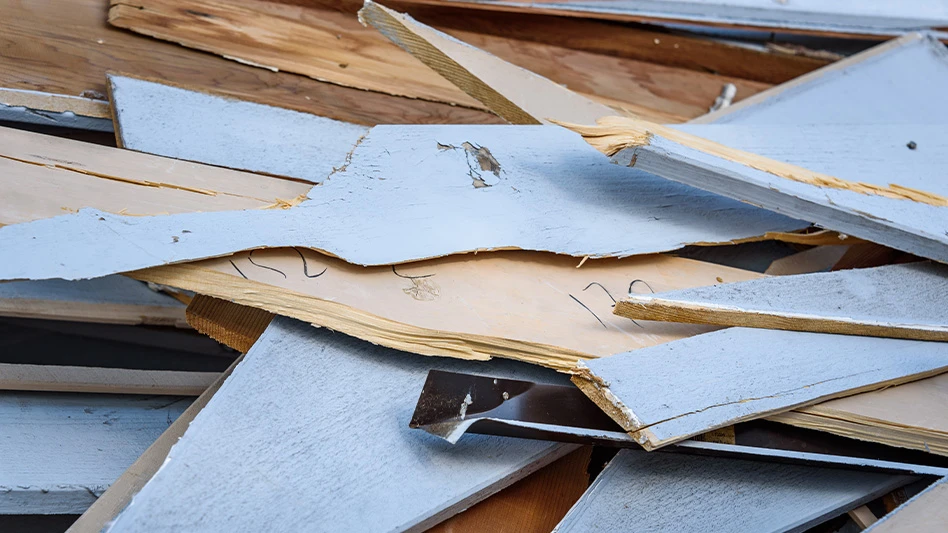
The main problem is identification of CCA wood. Especially if weathered, it looks remarkably similar to regular waste wood. Technologies are available to detect CCA wood in a facility’s infeed, but all have serious drawbacks. For example, a chemical stain put on all the incoming wood can tell which is CCA tainted, but it is very labor intensive to administer and then sort out. Mechanical means to detect and sort out CCA wood use x-rays or laser to detect the contaminant and then rely on mechanical sorting to jettison the offending pieces show promise, but require very expensive capital investments. Neither method has proven itself yet in a high-production setting.
Latest from Construction & Demolition Recycling
- Des Moines project utilizes recycled wind turbine blades
- Vecoplan to present modular solutions at IFAT 2026
- Terex Ecotec appoints Bradley Equipment as Texas distributor
- Greenwave raises revenue but loses money in Q2 2025
- Recycled steel prices hold steady
- John Deere launches ‘Building America’ excavator contest
- Triumvirate Environmental acquires Environmental Waste Minimization
- Coastal Waste & Recycling expands recycling operations with Machinex