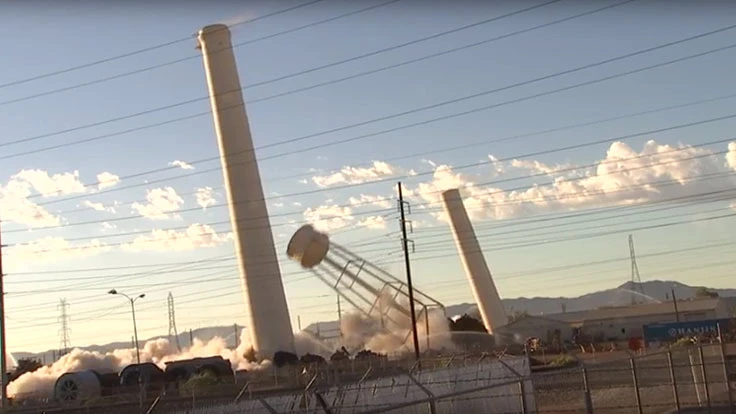
Crews imploded a water tower and two stacks at an APS power plant in Phoenix at 7 a.m., Saturday, Oct. 1, 2016.
The structures were built in the 1930's and according to local reports were part of the old oil-fired steam units at this power plant. At one point, this power plant was one of the largest energy-producers for the city of Phoenix.
The implosion was closed public viewing due to safety concerns.
The power plant has been there since the 1930s. It was decommissioned back in 2001 and has since sat silent.
The implosion marked marking the end of a nine-month deconstruction project of the old plant.
In 2015, the seven generating units at the West Phoenix Power Plant generated nearly 560 percent more electricity (almost 1,000 MW) than the former version of the facility, using cleaner natural gas and more efficient combined-cycle units.
“The sheer amount of energy, how much cleaner that energy is, and how much faster that energy can come online to serve our customers is something that was unimaginable 80 years ago,” said Ann Becker, APS vice president of environmental and chief sustainability officer. “The West Phoenix Power Plant of today is producing the type of efficient energy that can continue to serve the future generations of Valley residents, and we are proud to be able to carry on that legacy.”
While West Phoenix is producing more energy than ever before, it has also lowered emissions, significantly reducing nitrogen oxide emissions by 92 percent, sulfur dioxide emissions by 99 percent and carbon monoxide emissions by 96 percent compared to the former plant. APS’s overall generating portfolio is cleaner than ever before as well, with nearly half of its energy coming from carbon-free resources. Today’s plant continues to provide safe and reliable energy for nearly 250,000 homes.
APS notes, in 1930, Arizona was home to 435,573 residents, the Hoover Dam was a year away from the start of construction, and the original Phoenix Power Plant at the corner of 43rd Avenue and Buckeye Road was put into service by Central Arizona Light and Power Co. (CALAPCO). With a capacity of 18 megawatts, the plant supplied enough electricity to power all of Phoenix (with a then population of nearly 50,000) and the surrounding community.
Much has changed in the succeeding 86 years – both in the state and for CALAPCO, now known as Arizona Public Service (APS). Arizona’s population has swelled to nearly seven million, and the oil-fired steam units of the old Phoenix Power Plant, on what is now the site of the West Phoenix Power Plant, have been out of service since 2001. The structures of the old plant were left in place as cleaner and more efficient generating units replaced the old steam units, but now it is time to tear them down completely.
“To think back on the opening day of this plant in 1930, when the country was in the grip of the Great Depression and the surrounding area was mostly farmland, and to compare it to today’s modern plant and the community that has developed around it is pretty astounding,” said David Hansen, vice president of fossil generation at APS. “It’s a testament to how APS has grown up alongside Arizona.”
Latest from Construction & Demolition Recycling
- Greenwave raises revenue but loses money in Q2 2025
- Recycled steel prices hold steady
- John Deere launches ‘Building America’ excavator contest
- Triumvirate Environmental acquires Environmental Waste Minimization
- Coastal Waste & Recycling expands recycling operations with Machinex
- Reconomy acquires German-based GfAW
- CommanderAI launches HaulerCentral database
- Glass Recycling Foundation releases 2025 Impact Report