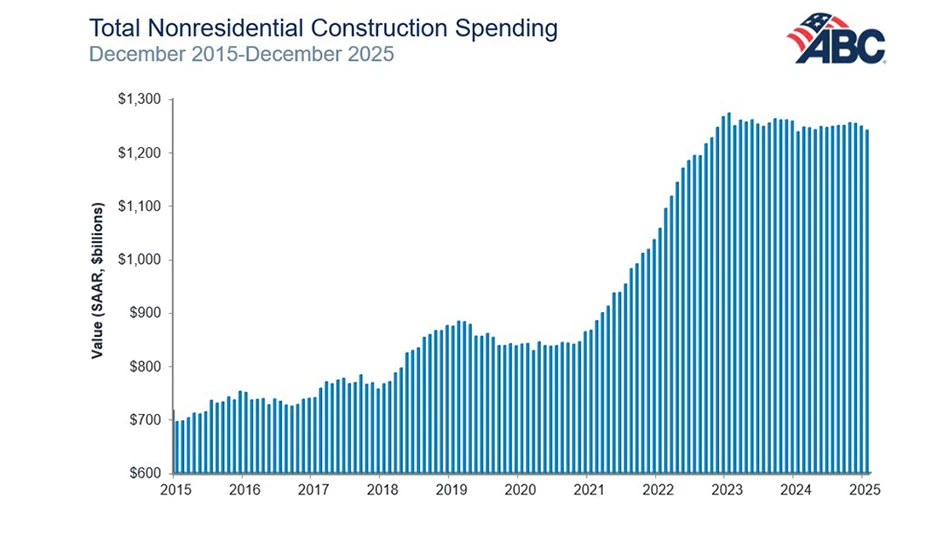
Nonresidential construction spending increased in March, although the positive news was somewhat overshadowed by another decline in spending overall, according to monthly statistics released by the Census Bureau.
“Nonresidential construction spending rose an impressive 1.3 percent in March and 12 percent compared to March 2007,” says Ken Simonson, chief economist for the Associated General Contractors of America (AGC), commenting on the figures. “The housing slump buried this news by dragging total spending down by 1.1 percent for the month and 3.4 percent for the year. Yet nearly every category of nonresidential spending continued to exceed year-ago levels.
“In addition, estimates for nonresidential spending in January and February were each revised up, suggesting that gross domestic product (GDP) may have grown a little more in the first quarter than the Bureau of Economic Analysis (BEA) said yesterday,” Simonson continues. BEA reported that real (net of inflation) GDP grew 0.6 percent, the same as in the fourth quarter of 2007.
“Both private and public nonresidential construction are still growing, although public spending is losing speed,” Simonson says. “Private nonresidential spending was up 15 percent from March 2007, whereas public spending grew 7.2 percent.”
Simonson says he expects a further slowdown in public spending as revenues flatten or even shrink for highways, schools and other public projects. “On the private side, I expect ongoing vigor in spending on power, energy, communications, hospital, higher education and military base realignment-related projects to offset a likely retreat by office and retail construction,” he says.
According to Simonson, the biggest challenge facing nonresidential construction is skyrocketing materials costs. “Yesterday, a steel supplier told customers the price of rebar was rising another $100 overnight, compounding increases of 40 to 70 percent earlier this year. The retail price of diesel fuel is now almost 50 percent higher than a year ago. Copper is close to its all-time high set in May 2006, and near-record prices for oil and natural gas may push up asphalt and plastics prices,” he says.
“It is essential that public budget-setting and contracting agencies recognize that construction costs have been rising at more than double the rate of consumer prices and seem sure to keep doing so,” Simonson adds. “With regard to highway construction, Congress must act immediately to prevent a huge drop in spending that will begin five months from today unless the Highway Trust Fund is replenished by the start of fiscal 2009.”
More information is available at www.agc.org and www.census.gov.
Latest from Construction & Demolition Recycling
- Waste Pro files brief supporting pause of FMCSA CDL eligibility rule
- Des Moines project utilizes recycled wind turbine blades
- Vecoplan to present modular solutions at IFAT 2026
- Terex Ecotec appoints Bradley Equipment as Texas distributor
- Greenwave raises revenue but loses money in Q2 2025
- Recycled steel prices hold steady
- John Deere launches ‘Building America’ excavator contest
- Triumvirate Environmental acquires Environmental Waste Minimization