Photo courtesy of Fornnax.
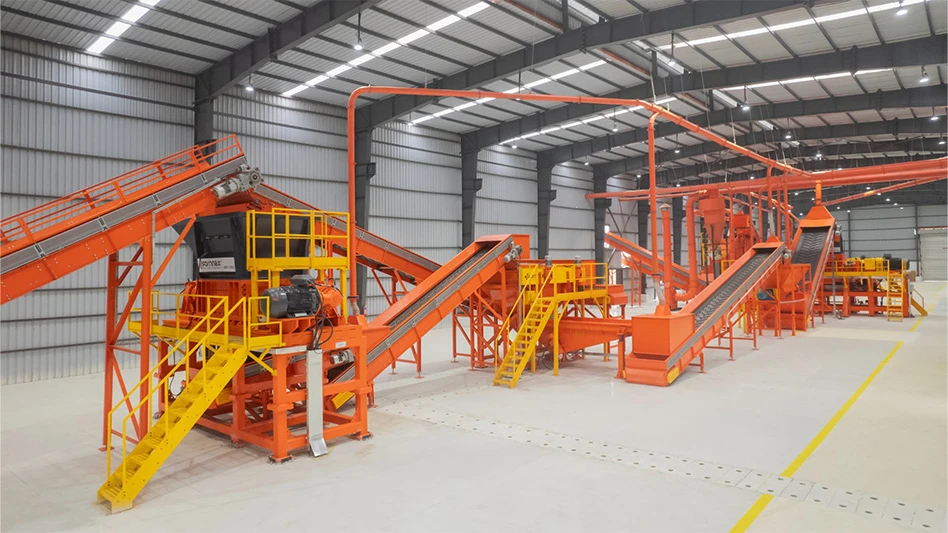
India-based recycling machinery producer Fornnax Technology has unveiled its new product development center and demo plant, which spans more than 12 acres, to advance global recycling technology.
The demo plant will serve as a hub for new product development, specifically designed to meet application demands, and the company plans to use the facility to upgrade its existing line of shredders and granulators by increasing their capacity, improving energy efficiency and reducing downtime.
These enhancements will increase equipment availability, Fornnax says, allowing for 18-20 hours of operation per day, and also validate the equipment for up to 3,000 to 15,000 hours under real-world conditions.
"Innovation in product development is the key to success of becoming a global leader," Fornnax Director and CEO Jignesh Kundariya says. "With this new facility, we now have the speed, flexibility and controlled environment to design, test and validate new technologies in just six to eight months, something that would take significantly four to five years at a customer site.”
Kundariya says each machine will undergo validation according to global standards, with every critical part and assembly tested under Engineering Build (EB) and Manufacturing Build (MB) protocols.
Gate review methodology
Fornnax says its new product development framework is based on a gate review process and ensures precision at every stage. The process begins with market research and ideation led by the company's sales and marketing team, followed by a review from its leadership team.
The company’s design team creates the designs, which are reviewed by its manufacturing, service and safety teams before final approval. Then, a functional prototype is constructed and tested for six to eight months during the validation phase.
The final stage involves optimizing the design for mass manufacturing, officially declaring the equipment ready for large-scale production.
Customer demonstration
Fornnax says the new facility has an open-door policy for customers. Clients who are unsure about which equipment is needed can bring materials to the center to observe performance across multiple machines and operating conditions.
The company says this approach provides a risk-free, real-world testing environment that empowers customers to make informed investment decisions.
The center also will support in-depth research on recycling applications such as e-waste, cables, lithium-ion batteries and other applications.
The company says its engineering and R&D teams will conduct feasibility studies and performance tests to design solutions for new or unfamiliar materials.
Future recycling solutions
The new facility houses an original equipment manufacturer (OEM) training center to develop operators and maintenance engineers for existing and future customers. Upon completion of the training module, trainees will be deployed at the Fornnax customer base to gain experience in assembly, disassembly and grinding operations.
Additionally, Fornnax says it will deliver corporate training to domestic and international clients, empowering them to operate plants with optimal efficiency, troubleshooting capabilities and effective maintenance practices for seamless integration and productivity.
Looking ahead, Fornnax plans to scale its offerings and capture a larger share of the global market by focusing on tire, municipal solid waste, e-waste, cable and aluminum recycling, along with new application areas such as auto shredder residue, lithium-ion batteries and more.
“Our goal is to empower customers with clarity and confidence before they invest,” Kundariya says. “This facility allows them to test their own materials under real-world conditions, compare machines and see results firsthand. It’s not just about selling equipment; it’s about building trust through transparency and delivering solutions that truly work for their unique needs.”
Latest from Construction & Demolition Recycling
- Sybilion seeks to help manufacturers confidently address volatility
- Construction backlog rebounds in February
- USTR to study additional steel, aluminum tariffs
- Shawmut commemorates National Women in Construction Week
- Holcim expands presence in Colombia with agreement to acquire Cemex operations
- eFactor3 enters into separation tech partnership
- Mitsubishi Logisnext Americas to rebrand as Logisnext Americas
- Burns Services diverts more than 1.2M tons of C&D materials from landfills