“Treated Wood in Transition: Less Toxic Options in Preserved and Protected Wood,” surveys the regulatory, legal and business aspects of what has happened in the treated wood market since chromated copper arsenate (CCA) was taken off the market in early 2004.
According to the feature, “The mainstream, copper-based replacements for CCA corrode fasteners more rapidly than CCA, increasing the risk of collapse for thousands of decks and other structures. Some of the new chemical treatment systems are entering the market with very little scrutiny from regulators, while one of the most promising treatment alternatives, TimberSIL, is the target of a campaign by the industry to get regulators to reclassify it as a toxic chemical —even though it isn’t toxic.”
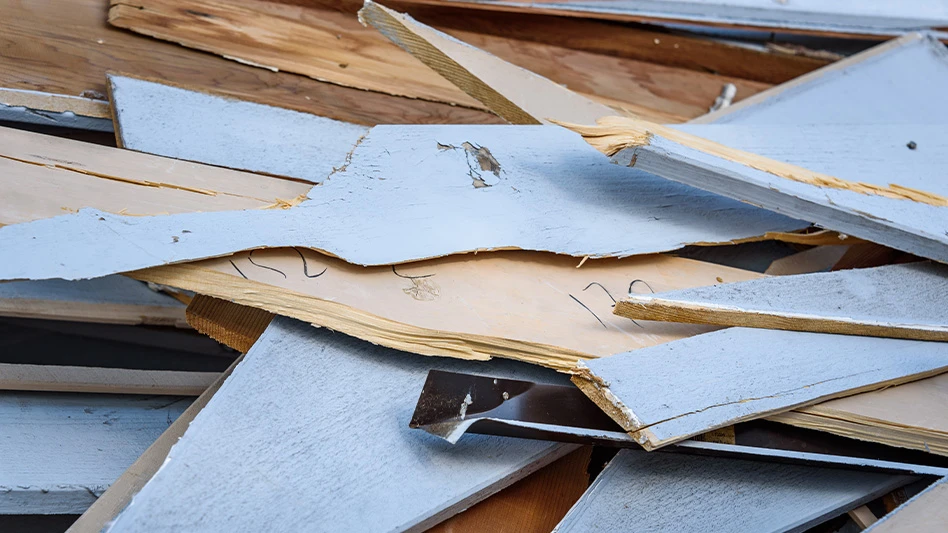
Of interest to wood and mixed C&D recyclers, the story’s author also writes, “[M]eanwhile, the 60 billion board feet (140 million m 3) of CCA-treated lumber that’s been put in service over the past 40 years is getting old; huge quantities are coming out of service and being disposed of, posing an environmental nightmare.”
The story notes that although CCA is no longer used in applications “where direct contact is likely, including playgrounds and most residential uses, such as decks,” the additive remain in applications such as “plywood (for both residential and commercial buildings), permanent wood foundations, timbers in commercial construction, marine pilings and piers, farm fencing, guardrails and sound walls along highways, and utility poles.”
Many of the CCA alternatives have indeed dropped the toxic heavy metals, but according to EBN, “Without chromium, which in CCA helps the copper bond tightly to wood, the protective chemicals may leach out. Perhaps more significantly, metal fasteners used with copper-based preservatives are more subject to galvanic corrosion and oxidation.”
The story’s author suggests, though, that a different new product could be a better option. “TimberSIL, produced by Timber Treatment Technologies, LLC (TTT) [uses] patented technology [that] essentially converts sodium silicate to an insoluble glass that surrounds and protects wood cells, making it unavailable to fungi and insects as a food source.” The product was named as a “Top 10 Green Product for 2004” by EBN-affiliated Web site BuildingGreen.com.
More information on BuildingGreen and its affiliated services and publications can be found at www.BuildingGreen.com.
Latest from Construction & Demolition Recycling
- Vecoplan to present modular solutions at IFAT 2026
- Terex Ecotec appoints Bradley Equipment as Texas distributor
- Greenwave raises revenue but loses money in Q2 2025
- Recycled steel prices hold steady
- John Deere launches ‘Building America’ excavator contest
- Triumvirate Environmental acquires Environmental Waste Minimization
- Coastal Waste & Recycling expands recycling operations with Machinex
- Reconomy acquires German-based GfAW