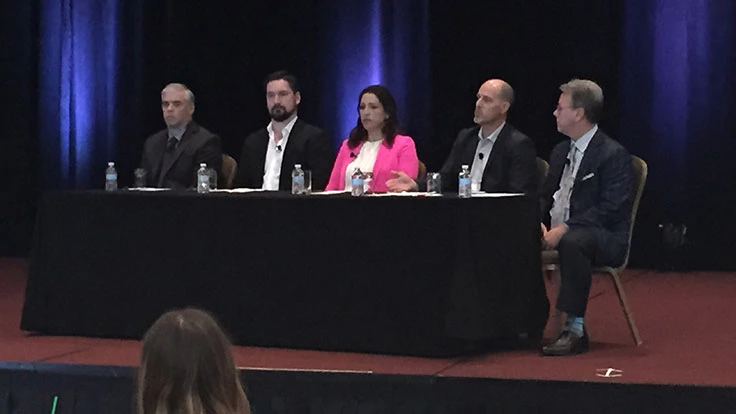
Pictured from left to right: Dennis McGarel, vice president, sales, at Brandenburg Inc.; James Milburn, owner, Milburn LLC; Simone Bruni, president, Demo Diva; Scott Knightly, president, EnviroVantage; Jim Graham, principal, Winter Environmental.
Today’s work force has many challenges. Keeping multiple generations and cultures engaged in the work force when all have different needs was just one of several issues around workforce development discussed during a panel at Demolition 2016. Five panelists running demolition firms all over the country, varying in size and both union and nonunion labor types, were able to share ideas that work for their operations, during the session moderated by Judy Ferraro, Judy Ferraro & Associates, a Lemont, Illinois-based education and training firm.
Keeping workers of each generation engaged when it comes to education, career opportunities and metrics for rewards can involve different approaches depending on the age of the employee. James Milburn, owner, Milburn LLC, Hillside, Illinois, said, “A little different communication for each age bracket goes a long way.” Milburn, who himself is a millennial, notes that his responds to positive feedback.
Jim Graham, principal of Atlanta-based Winter Environmental, added, “Millennials are very social. They solve problems differently.”
Panelists also shared their approaches to hiring, retaining and training workers.
Winter Environmental uses industrial psychologists, when they are close to making professional hires. They are given personality tests and evaluations. Graham said, “We use that to benchmark their performance. It gives us an opportunity to make and focus on their weaknesses.”
Scott Knightly, president, Epping, New Hampshire-based EnviroVantage, says his firm has found success with referrals of friends and family from current employees as well as relying on temp labor to fill positions.
Simone Bruni, president of New Orleans-based Demo Diva, says she has had success finding employees from other companies and vendors that have gone out of business. She has found truck drivers and equipment operators that way. Demolition Diva also has partnered with the local district attorney’s office on a work release program and has partnered with local charities that help the less fortunate.
Dennis McGarel, vice president, sales, at Brandenburg Inc., said the Chicago-based demolition firm hires a lot of summer interns in the hopes they will want to pursue a career with the firm.
Some of the companies represented on the panel, such as EnviroVantage and Demo Diva have had success with labor pools, while others like Winter Environmental don’t use them. “We want our employees doing the work on our jobs,” said Graham.
Training tactics also varied among panelists. The Illinois-based panelist Millburn and McGarel both said their firms rely on unions for a significant amount of training.
“The union offers a good amount of training certificate programs,” said Millburn.
McGarel said Brandenburg relies on unions. “They have done a really good job. They have really stepped up their training,” he said. He noted, however, “That piece of paper [from the unions] is important, but it is just a first step.”
The next step is site-specific training, reinforced by Brandenburg’s own training. He said Brandenburg offers extensive training to its supervisor and uses that training as a way to retain them as the company pays them above scale. “They see the investment we are making in them,” says McGarel.
Getting young people interested in a demolition career also was a challenge panelists addressed. Bruni recommended pushing the insurgence of vocational schools. “There has to be some movement back to that,” she said.
Knightly said parents are not laying the demolition field out as an option for their kids. He mentioned that as you go up the latter in the field, the pay can be quite lucrative.
Panelist also addressed audience questions regarding hiring veterans and women.
Department of Defence (DOD) projects, Graham said, have a prerequisite that 15 percent of the work force on that project are required to be veterans. Winter Environmental has had mixed success with hiring veterans. According to Graham, many them do not want to travel any more now that they are out of the service. “We haven’t been able to attract young military,” he said.
While not many women are going out for jobs in the demolition field, panelists agreed those who have showed a strong attention to detail and have been reliable hires.
Retaining employees really comes down to one basic principal. “We just try to treat them better than the competition,” said Millburn.
Demolition 2016 was March 14-17 at the Orlando World Center Marriott, Orlando, Florida.
Latest from Construction & Demolition Recycling
- Vecoplan to present modular solutions at IFAT 2026
- Terex Ecotec appoints Bradley Equipment as Texas distributor
- Greenwave raises revenue but loses money in Q2 2025
- Recycled steel prices hold steady
- John Deere launches ‘Building America’ excavator contest
- Triumvirate Environmental acquires Environmental Waste Minimization
- Coastal Waste & Recycling expands recycling operations with Machinex
- Reconomy acquires German-based GfAW