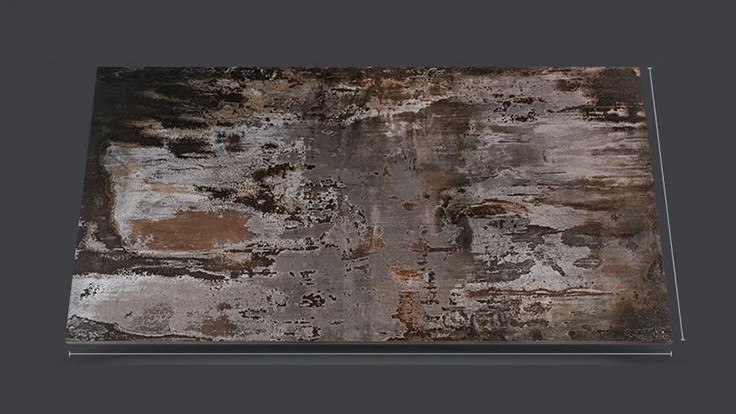
Dekton, Sugar Land, Texas, by Cosentino, has expanded its color offerings to include three new colors in the XGloss Naturals collection. Also making its debut is Trilium, a color manufactured from materials recycled from its own production process.
Trilium is designed to capture the visual texture and color variation of aged and oxidized stainless steel, with hues ranging from deep grays and blacks to rusty undertones. This is the first time Dekton has used recycled materials in its manufacturing process. Unlike the material that inspired it, Trilium is designed to be smooth to the touch and impervious to the elements, scratches, stains, UV rays and temperature shock.
The ultra-compact surface also introduces its XGloss Naturals series, comprised of three new colorways that offer a modern take on marbles. Glacier is designed with warm veining on creamy undertones, while Fiord features contrasting colors of white, cream and gray. Tundra combines cream and ocher hues.
"Both designers and homeowners are putting a greater emphasis on durability and ease of care when it comes to their material selections," says Lorenzo Marquez, vice president of marketing for Cosentino North America. "Cosentino has developed advanced technology that captures the depth, drama and beauty of stone but in a material that's ultra-resilient against everyday use. The aesthetic and performance of Dekton go hand in hand."
Dekton is suitable for an array of indoor and outdoor applications, including countertops, façades, cladding, flooring and stairs, according to the company. It is available in large format.
Latest from Construction & Demolition Recycling
- Vermeer announces plan to build new facility in Des Moines metro area
- Capstar Disposal expands roll off dumpster rental services
- Supreme Court strikes down IEEPA tariffs
- Casella details facility closures, expansion efforts
- DPR Construction cuts ribbon on Silicon Valley office, prefab facility
- Constellium posts record Q4 adjusted EBITDA
- Amrize closes PB Materials acquisition
- QCC torches include customizable features