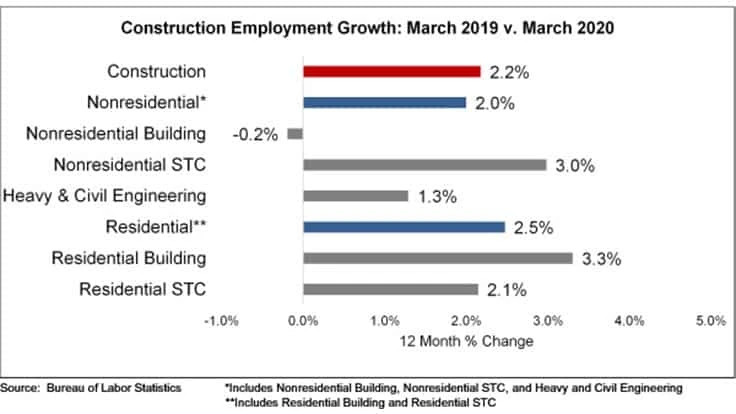
Construction industry employment declined by 29,000 in March, according to an Associated Builders and Contractors (ABC) analysis of data released April 3 by the U.S. Bureau of Labor Statistics. Nonresidential construction employment declined by 24,600 in March.
“So ends the lengthiest expansion in American economic history,” says Anirban Basu, ABC’s chief economist. “The expansion was associated with dramatic asset price increases, multi-decade lows in unemployment, persistently low costs of capital and a thriving U.S. nonresidential construction sector. While the March jobs report is horrific, ending a 113-month streak of employment gains, it is clear that employment reports in future months are likely to be even worse.”
All three nonresidential segments registered job losses, with the largest decrease experienced in nonresidential building (-10,700) followed closely by heavy and civil engineering (-10,200). Nonresidential specialty trade lost 3,700 jobs on net.
The construction unemployment rate was 6.9 percent in March, up 1.7 percentage points from the same time one year ago. Unemployment across all industries rose from 3.5 percent in February to 4.4 percent last month, a direct result of the global pandemic.
According to Basu, what remains unclear is the extent to which estimated construction employment declines are due to mandated suspension of projects in Massachusetts, Pennsylvania, California and elsewhere, and how much of this is due to the emergence of recessionary forces.
“Generally, nonresidential construction is one of the last segments of the economy to enter recession as contractors continue to work down their collective backlog, which stood at 8.9 months in ABC’s Construction Backlog Indicator,” Basu says. “The need for social distancing renders that statistic less pertinent, meaning that nonresidential construction is susceptible to large-scale job losses immediately.”