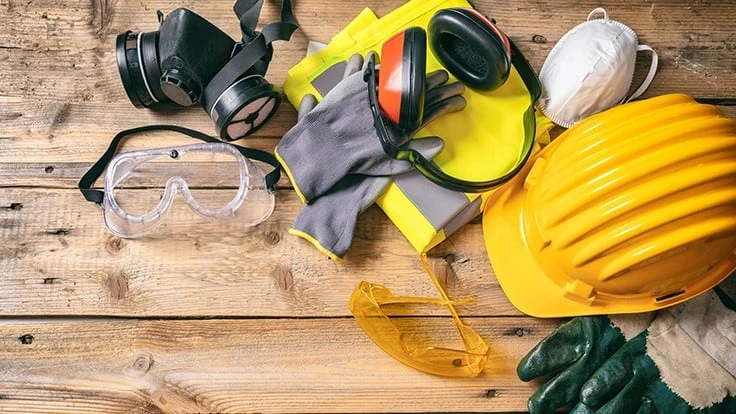
According to panelists on the Commercial Observer’s second annual Construction Safety Forum, new construction safety guidelines will not just focus on wearing hard hats or mitigating falls, but checking workers temperatures before they enter job sites, staggering start hours and making sure masks are worn at all times due to the coronavirus pandemic.
Experts who spoke on forum said that measures taken to mitigate the spread of COVID-19 on the few job sites allowed to remain open now will likely impact future construction safety guidelines.
“This time is going to set the trends for the future of how work will be in the construction industry,” Paul Meli, the director of construction safety and risk management for New York-based Triton Construction Company, said during the first panel “The Latest in East Coast Construction Safety Policy and Regulations.” “They will be forced — for lack of a better description — to use technology to interact more with the science and engineering side and to use the opportunity for us now to take this construction industry, as a whole, to the next step. I think it’s important because I feel it’s been long overdue.”
For example, Skanska, Stockholm, Sweden, has digitized its management system during this time — which includes manuals and hazard analysis — and adapted its remote video auditing system usually used to identify loading issues to track social distancing on job sites.
“That has been huge and helps us to enforce compliance here,” said Paul Haining, the chief environmental health and safety officer for Skanska. “Our COVID-19-related cases across the U.S. reduced by 76 percent since we implemented this technology.”
While in late March many cities halted non-emergency construction to slow the spread of COVID-19, some job sites were deemed essential and allowed to continue leaving contractors scrambling to implement changes to increase worker safety.
Cauldwell Wingate, New York, has about 11 essential projects ongoing — mostly health-care-related ones — and tries to weed out potential COVID-19 cases before they even step foot on the site.
“You’ll see now if you come out on job sites you’re going to run into somebody take your temple scanning of your temperature,” said George Braun, Cauldwell’s vice president of corporate safety, during the panel. “You’re going to receive a questionnaire asking, ‘Have you come into contact with anybody, do you have any of the symptoms of COVID?’ So, we can rule these people out before they get on the job site.”
Braun said that Cauldwell added markings to show where people can walk, one-way staircases and foot-pedal hand sanitizers for workers.
And while the number of construction projects has dropped, the ones still open have seen a large decrease in the number of injuries on the site, which Haining said Skanska hopes to continue in the future.
Latest from Construction & Demolition Recycling
- Waste Pro files brief supporting pause of FMCSA CDL eligibility rule
- Des Moines project utilizes recycled wind turbine blades
- Vecoplan to present modular solutions at IFAT 2026
- Terex Ecotec appoints Bradley Equipment as Texas distributor
- Greenwave raises revenue but loses money in Q2 2025
- Recycled steel prices hold steady
- John Deere launches ‘Building America’ excavator contest
- Triumvirate Environmental acquires Environmental Waste Minimization