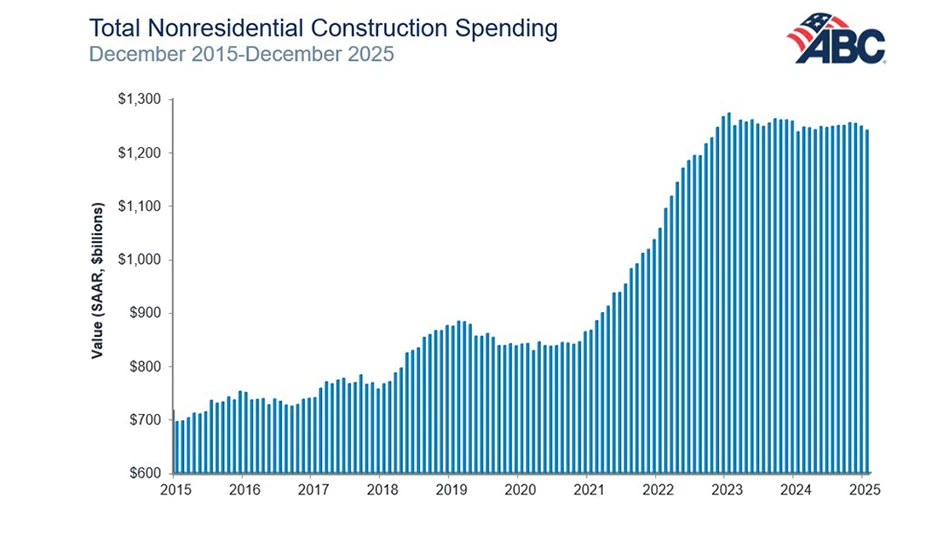
Construction employment grew in only four out of 337 metropolitan areas in 2009 as spending on construction projects dropped by $100 billion in December to a six-year low of $903 billion, according to a new analysis report of federal figures by the Associated General Contractors of America (AGC) released on Feb. 1, 2010.
"The impact of the stimulus is clearly being overshadowed by the sweeping downturn in overall construction demand," says Ken Simonson, the association's chief economist. "Without those public investments however, a bad employment situation will only get worse during 2010."
Simonson notes new Census Bureau figures, released on Feb. 1, show that private non-residential spending dropped 18 percent in December 2009, compared with December 2008. He adds that only power construction increased from year-ago levels, by 14 percent. Developer-financed categories recorded especially large declines, including lodging (down 46 percent); retail, warehouse and farm (down 37 percent); and office (down 35 percent).
In contrast, publicly funded construction increased by 1 percent between December 2008 and 2009, Simonson notes. He says that stimulus spending helped boost highway and street construction by 3.7 percent, making it the largest public category.
Educational construction dropped 4 percent during the year. Private residential construction dropped 11 percent for the year as multi-family construction tumbled, even though spending on single-family housing has increased for seven months in a row.
Simonson says the declines in construction spending resulted in layoffs in almost every community.
Leominster-Fitchburg, Mass., lost a larger percentage of its construction work force (38 percent) during 2009 than any other metropolitan area according to the latest Bureau of Labor Statistics figures.
Other areas experiencing sharp declines in construction employment during the year include El Centro, Calif. (36 percent); and Santa Fe, N.M.; Pocatello, Idaho; and Kokomo, Ind. (all down 29 percent). Meanwhile, the Houston area lost the most construction jobs (25,500) between December 2008 and 2009.
Of the four metropolitan areas with an increase in construction employment during the past 12 months, only two areas had gains of more than 100 jobs: Harrisburg-Carlisle, Pa. (1,500 jobs, 13 percent gain) and Tulsa, Okla. (700 jobs, 3 percent gain). Two metro areas had gains of 100 jobs each in construction: Springfield, Ohio (8 percent) and Columbus, Ind. (5 percent).
Association officials caution that without new investments in infrastructure projects, construction employment will likely get worse. They note that the fiscal year 2011 budget request outlines some important new infrastructure investments, including establishing a national infrastructure fund and boosting investments in high speed rail and new air traffic control facilities. Many of those new investments, however, were offset by cuts for new water infrastructure projects and levee projects, for example.
"Failing to make vital investments in our infrastructure will cost even more jobs while undermining our ability to compete globally for years to come," says Stephen E. Sandherr, the association's chief executive officer.
More information about construction spending statistics is available by clicking here.
Latest from Construction & Demolition Recycling
- Greenwave raises revenue but loses money in Q2 2025
- Recycled steel prices hold steady
- John Deere launches ‘Building America’ excavator contest
- Triumvirate Environmental acquires Environmental Waste Minimization
- Coastal Waste & Recycling expands recycling operations with Machinex
- Reconomy acquires German-based GfAW
- CommanderAI launches HaulerCentral database
- Glass Recycling Foundation releases 2025 Impact Report