With construction figures calculated for the first half of 2004, the year is shaping up as one where the residential segment will again serve as the source of growth within the construction industry.
In June, infrastructure construction (public works, including highway projects) rebounded after a weak May, and offset the mild slippage registered for the month by nonresidential building and housing. During the first six months of 2004, total construction on an unadjusted basis was reported at $286.2 billion, a 10 percent gain compared to the same period a year ago, according to McGraw-Hill Construction, New York.
Since January, new construction starts have seen gradual improvement, regaining the elevated level that was achieved at the end of last year. June was helped by a stronger volume of public works construction, which so far in 2004 has been one of the weaker construction sectors, according to McGraw-Hill Construction vice president of economic affairs Robert A. Murray.
The gain may have been temporary, however, as the sector will still be limited by tight fiscal conditions facing the federal and state governments. During the first half of 2004, the construction industry continued to be supported by the robust performance of single family housing, in combination with stability for commercial building.
However, it’s expected that the second half of 2004 will see single-family housing ease back a bit, with commercial building becoming the sector most likely to pick up the slack.
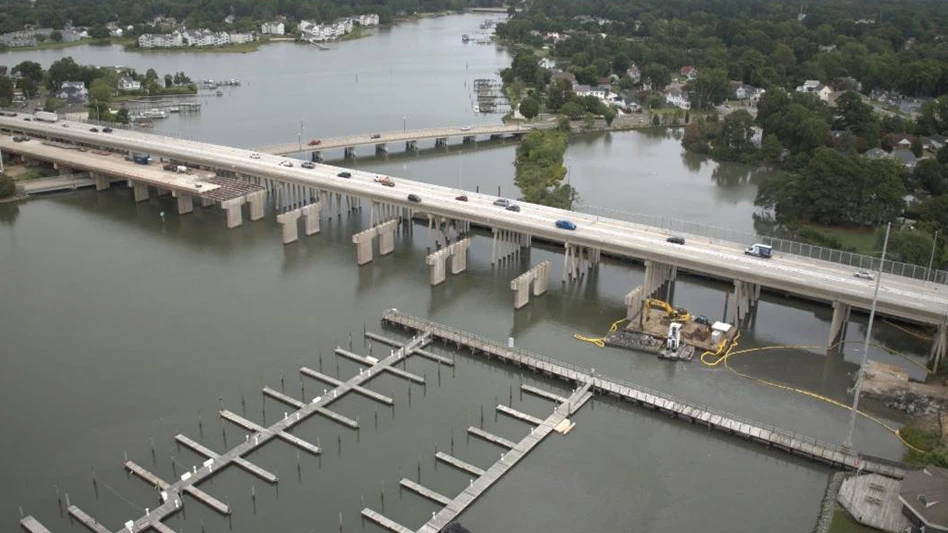
The June gain in infrastructure work included gains reported in several categories, including highway spending up nine percent; bridge constructions up 13 percent; river/harbor development up 18 percent; and sewer work up 47 percent, with three major sewer projects undertaken in Georgia, Virginia and Pennsylvania.
The June improvements were not enough to lift overall first-half numbers, with contracts for work checking in at 4 percent below the first half of 2003. The most pronounced weaknesses were registered by highways, down 11 percent, and bridges, down 29 percent.
This year’s volume of highway and bridge construction has faced several constraints, including tight fiscal conditions for the states and the difficulties caused by this year’s steep rise in steel prices. In addition, the last multi-year federal transportation bill expired on September 30, 2003, and Murray notes, the lack of a replacement bill this year has produced an uncertain funding horizon for state departments of transportation, hampering their ability to approve major new projects.
The commercial construction sector has remained relatively flat in 2004, registering a one percent overall decline in new contract values. School construction, down 4 percent, has dragged the institutional sector down, while spending for churches, transportation terminals, public buildings and health care facilities has increased mildly.
Manufacturing and industrial construction has been down 24 percent from the first half of 2003. The commercial categories include a 5 percent reduction for offices. Stores and warehouses in the first half of 2004 were essentially steady with 2003, registering slight declines of 1 percent and 2 percent, respectively, while hotel construction in the first half of 2004 was up 8 percent over the year before.
Contracts to build new single-family houses held steady in June, but multi-family housing retreated 12 percent from a very strong May. For this year's first half, residential building was up 20 percent compared to its lackluster performance during the first half of 2003.
Latest from Construction & Demolition Recycling
- Terex Ecotec appoints Bradley Equipment as Texas distributor
- Greenwave raises revenue but loses money in Q2 2025
- Recycled steel prices hold steady
- John Deere launches ‘Building America’ excavator contest
- Triumvirate Environmental acquires Environmental Waste Minimization
- Coastal Waste & Recycling expands recycling operations with Machinex
- Reconomy acquires German-based GfAW
- CommanderAI launches HaulerCentral database