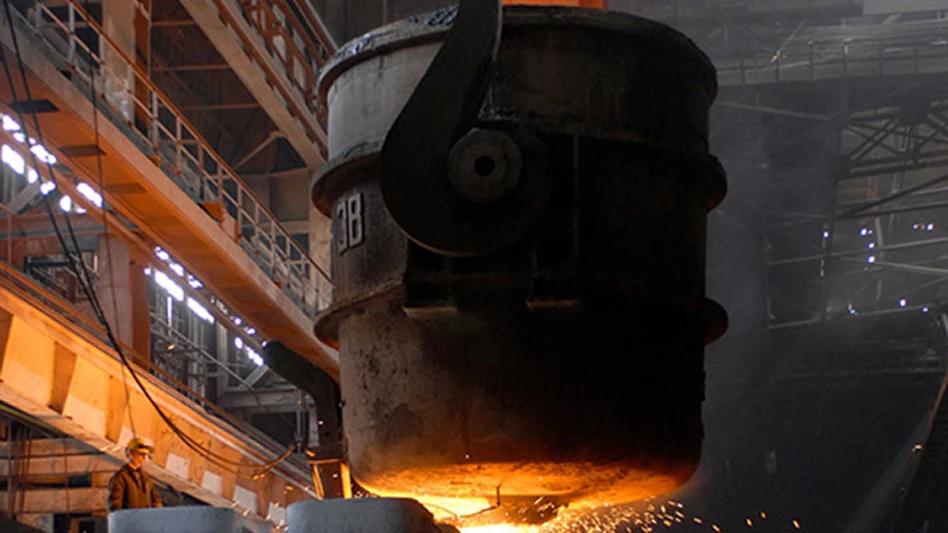
Photo courtesy of ArcelorMittal
Figures for construction employment and passenger vehicle sales this February both registered as disappointments, with the steel and metals recycling sectors that supply those industries waiting to see if winter weather is the main culprit rather than a slowing economy.
Statistics gathered by the United States Bureau of Labor Statistics and analyzed by the Washington-based Associated Builders and Contractors (ABC) indicate the construction industry in the U.S. lost 11,000 net jobs this February.
ABC says the construction sector unemployment rate was 6.9 percent in February, outpacing an overall 4.4 percent unemployment rate in the U.S.
“Construction employment shrank again in February and has now declined in eight of the past 11 months,” says ABC Chief Economist Anirban Basu. “Both the residential and nonresidential segments lost jobs for the month, adding to a recent string of downbeat industry data releases.”
There are seasonal aspects to the construction activity level in the U.S., with the first two months of 2026 offering some particularly harsh winter weather. Winter storms can halt work at some outdoor work sites and delay the delivery of needed materials.
The nation’s other large steel-consuming industry, the automotive sector, also experienced a subpar February in terms of passenger vehicle sales, according to Atlanta-based Cox Automotive.
That firm says February 2026 passenger vehicle sales of 1.20 million units rose by 8.5 percent after a particularly harsh winter sales climate this January.
However, February sales were lower compared with one year earlier, “aligning more closely with the slower sales pace in the final quarter of 2025,” according to Cox, which says the automotive sales pace has been lower year over year for five consecutive months.
The early 2026 stalled momentum in the two sectors may have been a factor for declines in weekly American steel output in the last week of February and the first week of March.
Steel mill production in the week ending Feb. 28, 2026, was down 0.3 percent from the previous week, according to the Washington-based American Iron and Steel Institute (AISI).
That was followed by a 1.1 percent week-on-week decline in output during the week ending March 7, 2026. According to AISI, weekly output in the U.S. has fallen from 1.817 million tons in the week ending Feb. 21, to 1.791 million tons in the week ending March 7, a drop of 26,000 tons.
Construction sector analysis by the Virginia-based Associated General Contractors of America (AGC) says activity in the nonresidential and infrastructure sectors remains strong.
“Even with the monthly drop, construction employment has grown at a faster rate during the past year than the broader economy,” says Macrina Wilkins, the AGC’s director of market insights.
In the automotive sector, Cox Automotive says, “Broader uncertainty remains a headwind for shoppers,” but also refers to March as “traditionally a big month for new vehicle sales.”
Last year, auto dealers enjoyed strong March sales figures, with some of those sales likely generated when buyers snapped up models imported before tariffs were implemented. Cox Automotive says it “is not expecting a repeat performance this year.”
Latest from Construction & Demolition Recycling
- John Deere launches Extended Reality Training System
- Demolition of Northeastern University’s historic Matthews Arena begins
- Cleveland Browns begin excavation for new stadium
- Construction industry loses 11,000 jobs in February
- ALLU offers new crusher bucket
- Waste Pro files brief supporting pause of FMCSA CDL eligibility rule
- Des Moines project utilizes recycled wind turbine blades
- Vecoplan to present modular solutions at IFAT 2026