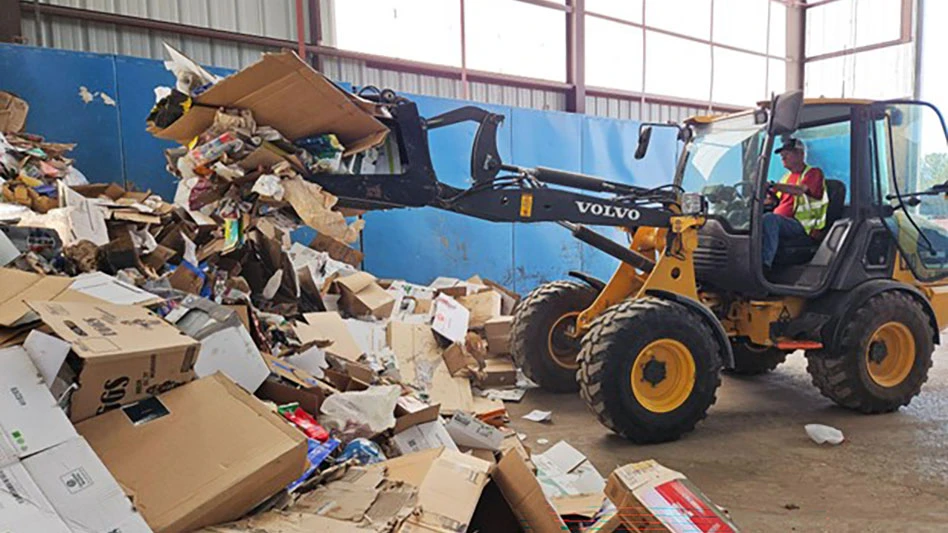
Photo courtesy of Volvo Construction Equipment
Phoenix Recycling has a habit of setting trends. Before the company opened in 2001, residential trash and recycling collection in La Plata County in southwest Colorado was available only in the city of Durango, so Phoenix brought the service to the rest of the county. In 2006, the company became the first in the state to offer construction waste recycling: hauling materials to its facility to sort, process and reuse if possible.

Just a year after the most commonly used LEED (Leadership in Energy and Environmental Design) ratings were established, Phoenix Recycling began contributing to LEED-certified building projects. When the company built a new facility in Durango 2016, it became the only one in the county to sort single-stream recycling and construction debris on one set of conveyors.
This year, Phoenix became the first waste and recycling operation in the area to incorporate electric heavy equipment into its fleet. Its machine of choice? An L20 Electric compact wheel loader (CWL) made by Volvo Construction Equipment, with North American headquarters in Shippensburg, Pennsylvania, and purchased from Power Equipment Co., which has a location in Durango.
“This machine is the perfect size for the job it’s doing,” says Mark Thompson, owner and manager of Phoenix Recycling. “We’re not pushing it to its limits yet, and it can definitely handle everything that our old diesel machine did.”
At about 10,000 pounds, the L20 Electric loader has a 1.05-cubic-yard bucket and can work with other attachments like a fork or a plow. The team primarily uses it to scoop waste from a pile and dump it onto a conveyor for sorting.
Because state regulations dictate that waste must be processed indoors (with a carbon monoxide alarm), the CWL is never far from power—though it’s not usually needed during a shift. Thompson says an overnight charge will last all day, but operators sometimes plug it in over lunch to top it off.
“It’s always within 150 feet of an outlet,” he says. “We planned to install a 220-volt outlet but haven’t needed it yet. We’re just using a standard 110-volt outlet and can hardly believe it.”
Thompson says Phoenix could add another shift eventually, which could require adjustments to the charging schedule or prompt the company to upgrade to the 220-volt outlet for faster charging.
A simple journey to sustainability
Phoenix Recycling always is looking for ways to work more sustainably, so when Thompson and a couple of his employees attended a 2024 operator training event at a Power Equipment branch in Grand Junction, he was eager to learn about and try the battery-powered wheel loader.
“I thought it was really cool, and it led me to do some research,” he says.
A little over a year later, when his diesel CWL from another brand broke down, the Volvo L20 Electric came to mind, and Thompson reached out to Stacey Mousner, a sales product support rep at Power Equipment’s Durango branch.
“It got here for a demo, and it never left,” he says. “We needed something right away, and we liked it, so that was that.”
Employees particularly have enjoyed the reduction in noise and fume levels.
“The fewer things that make noise in that space, the better,” Thompson says. “They like being able to hear their music, and there are no smelly diesel engine regens.”
As for a learning curve, the main operator of the L20 Electric wheel loader told Thompson it’s operationally the same as its diesel counterpart. After Mousner gave Phoenix a brief training and adjusted a couple of electronic features, the company was off and running.
“The dealer support was a big factor in my decision to get the machine,” Thompson says. “Being able to make a phone call and have someone show up quickly is big because we have a small team, and you can’t just call a local garage for things like this. Stacey is awesome to work with.”
Return on investment won’t take long
Battery-electric construction equipment currently has a higher purchase price than diesel equivalents, but several benefits could offset that investment fairly quickly.
“We have a diesel tank on-site for other machines, and I bet it won’t take long to notice the drop in our fuel consumption,” Thompson says.
The absence of an internal combustion engine and many of the moving parts found in diesel machinery means a significant reduction in maintenance time and supplies. too. In fact, Volvo conservatively estimates that users of its electric machines will save up to 35 percent in maintenance costs and time.
On top of that, electric machines don’t idle like diesel machines do, which eliminates unnecessary wear and tear and slows the accumulation of operating hours.
“We’re hoping to see a lower total cost of ownership over time,” Thompson says. He notes that Phoenix has not had any maintenance or repair needs in its first few months with the machine.
Depending on location, electric equipment purchases could qualify for grants or tax incentives. The company’s immediate need for the L20 Electric led Phoenix Recycling to purchase the machine outright, but Thompson says grants could have helped if it had time for that process.
Renewable power for an environmentally focused business
In addition to its residential and construction recycling business, Phoenix Recycling has a document shredding division and a biomass division, which removes and processes logging residuals from forests. Much of the company’s equipment is already electric, and Thompson plans to keep the transition going.
Phoenix currently uses a diesel-powered loader to feed material into an electric baler to prepare it for transport. But the plan is to replace all diesel-powered loaders and skid steers with electric versions as they age out, leading to a fully solar-powered fleet in the future.
“We’re in the process of installing solar arrays on the roof, so we’ll soon be operating entirely on solar power, including charging the L20 Electric,” Thompson says. “It makes for a great story to be able to say we use solar power and electric equipment, because the recycling industry is meant to support sustainability.”
Latest from Construction & Demolition Recycling
- Sybilion seeks to help manufacturers confidently address volatility
- Construction backlog rebounds in February
- USTR to study additional steel, aluminum tariffs
- Shawmut commemorates National Women in Construction Week
- Holcim expands presence in Colombia with agreement to acquire Cemex operations
- eFactor3 enters into separation tech partnership
- Mitsubishi Logisnext Americas to rebrand as Logisnext Americas
- Burns Services diverts more than 1.2M tons of C&D materials from landfills