Photo by Chris Sweeney
Recycling gypsum into productive end markets has many drivers, including conserving gypsum resources, improving the sustainability of new drywall products and avoiding hydrogen sulfide gas at landfills while extending their operational lifespan.
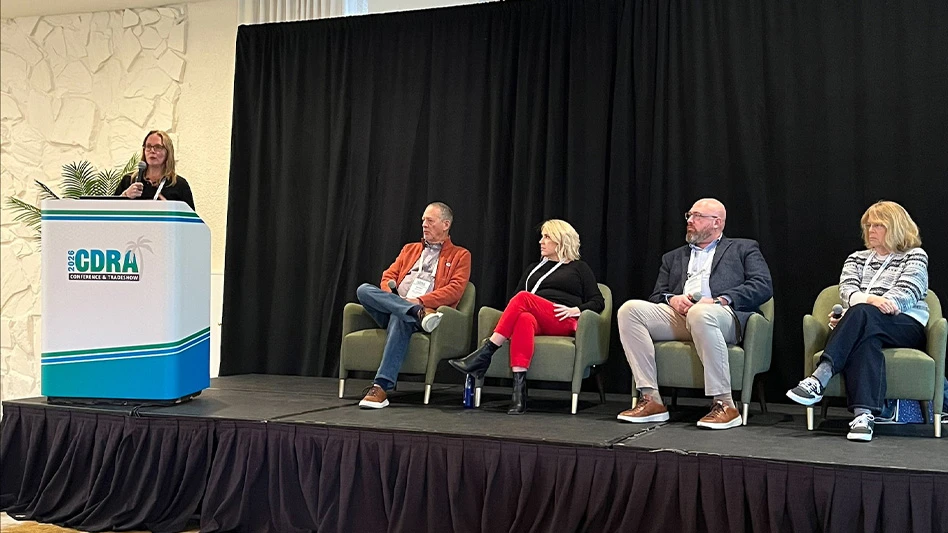
At the 2026 Construction & Demolition Recycling Association (CDRA) Conference & Tradeshow in Tampa, Florida, a panel of industry experts discussed gypsum drywall recycling drivers and challenges at the Gypsum Recycling Roundtable on Jan. 27.
Amanda Kaminsky, founder and principal of New York-based Building Ecosystems, moderated the session and explained that U.S. manufacturers only accept new construction trim scrap drywall for recycling, while postuse drywall, also called demo drywall, is not accepted. However, other places around the world recycle demo drywall.
Terry Weaver, president of Denver, Pennsylvania-based USA Gypsum, said to expand drywall recycling, there needs to be confidence that the amount of drywall waste available creates enough of a demand to justify the end market.
“How can you divert that drywall from the mixed waste stream?” Weaver asked. “That’s the real question that often needs to be answered.”
Brooke Fishel, director of stewardship and external affairs at Silver Spring, Maryland-based Gypsum Association, agreed, saying that if there’s no secondary market, there’s no reason to put infrastructure in place.
To make gypsum recycling more viable, Lincoln Young, president of Rockwood Sustainable Solutions, Lebanon, Tennessee, also said it comes back to having the market.
“If I’m the only producer in Tennessee, then we’re out of drywall in a couple of weeks,” he explained. “Why would the manufacturer want to put all that infrastructure in place if they didn’t have the quantity?”
Another factor in establishing gypsum recycling comes down to the cost. Lois Rose, landfill operations manager for Sarasota County, Florida, said if the cost of recycling isn’t in line with what customers are currently paying to get rid of the material, it likely won’t work.
For drywall manufacturers to accept postuse drywall, the U.S. needs technologies to break down the material given the requirements for manufacturing drywall.
“Our manufacturer’s first responsibility is creating a product,” Fishel said. “Liability is on their shoulders to create a product that is fire resistant; that protects families, homes and life; and that is ultimately going to be their responsibility. They can do whatever they want to do to be able to bring gypsum back ... they still have that responsibility.”
Latest from Construction & Demolition Recycling
- Sybilion seeks to help manufacturers confidently address volatility
- Construction backlog rebounds in February
- USTR to study additional steel, aluminum tariffs
- Shawmut commemorates National Women in Construction Week
- Holcim expands presence in Colombia with agreement to acquire Cemex operations
- eFactor3 enters into separation tech partnership
- Mitsubishi Logisnext Americas to rebrand as Logisnext Americas
- Burns Services diverts more than 1.2M tons of C&D materials from landfills