Photo by Chris Sweeney
Battery-related fires remain one of the most pressing safety challenges facing waste and recycling operations.
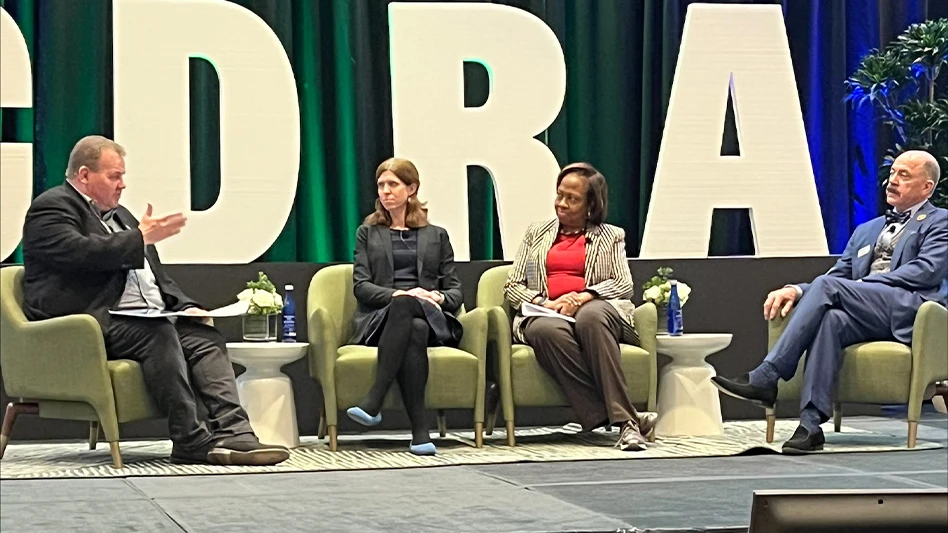
At the 2026 Construction & Demolition Recycling Association (CDRA) Conference & Tradeshow in Tampa, Florida, leaders from four industry associations discussed how the industry can respond during the Managing the Threat of Battery Fires panel Jan. 29.
Representatives from the Springfield, Illinois-based CDRA, the Solid Waste Association of North America (SWANA), the National Waste & Recycling Association (NWRA) and the Recycling Materials Association (ReMA) focused on battery fire prevention, detection and response.
“I appreciate having all three trade associations up here,” John Thomas, CDRA president and managing partner at Waste & Recycling Solutions of Berlin, New Jersey, said at CDRA 2026. “We need to flood the market with this education and information through every channel that all of us possibly can. … This is about a common fight that we're all having to fight together, and we can't do it alone.”
During the session, Thomas asked panelists what technologies operators are using to detect batteries before they cause fires in trucks, transfer stations or facilities.
Michael E. Hoffman, president of the Arlington, Virginia-based NWRA, said most facilities have made progress in detecting batteries, but removing them remains the biggest challenge.
“They’ve come at it with cameras. They’ve come at it with IR,” Hoffman said. “Let's take a material recovery facility, and if taking a modern one, they're trying to be at least at 45 tons an hour, up to 60, is the sort of new design of an MSW, single-string, modern facility. They can't turn the thing on and off, so having identified it, how do you get it out? And that's been the biggest challenge we can see. Pretty much everybody's figured out how to see them. … The getting it out part is the part that hasn’t been solved.”
Hoffman added that thermal detection technologies, such as FLIR thermal camera systems, are helping operators identify heat issues before they escalate into catastrophic incidents, but safely extracting batteries from high-throughput facilities remains difficult.
He also pointed to the NWRA’s campaign, a partnership with the U.S. Forest Service and The Battery Network, which uses the established Woodsy Owl character to promote the message “Skip the Bin – Turn Your Batteries In!” and encourage proper battery disposal.
RELATED: Battery recycling campaign hits test markets, while traditional markets remain challenged
Cheryl Coleman, senior vice president, advocacy, safety and sustainability of Washington-based ReMA, said technology alone is not enough. In combination with emerging technological advances, she emphasized the importance of employee training and a systems-based approach to battery safety.
“At ReMA, we believe that battery safety is a system,” Coleman said. “It’s not a single approach. It’s not a gadget. It is looking at it from a systems approach.” She added that trained drivers, route personnel and facility staff are essential to identifying and addressing batteries as early as possible.
Kristyn Oldendorf, senior director of public policy and communications at Silver Spring, Maryland-based SWANA, highlighted the role funding plays in whether municipalities can adopt fire detection and suppression strategies.
“With many of our members being municipal, it’s not like they’re having these huge budgets to be buying technologies,” Oldendorf said. She pointed to the need for grant funding and policy solutions, citing Maryland legislation that proposed creating a fund to support electronics recycling and fire prevention technology purchases.
Later in the discussion, Thomas noted that power tools and cell phone battery packs remain the most common sources of battery-related incidents at facilities.
“In our situation, over two landfills and seven transfer [stations], the majority of those batteries are power tool or cell phone batter packs,” he said. “Very rarely do we see a computer. Very rarely. It’s always those two.”
Panelists agreed that while progress is being made, addressing battery fires will require continued collaboration, education and investment across the industry.
Latest from Construction & Demolition Recycling
- Lakeshore Recycling Systems, MCS Recycling achieve RCI certification
- Iron Woman Logistics Services awarded grant to build Colorado C&D recycling facility
- Collective Waste Solutions acquires Alcop Resource Recycling transfer station
- Construction hiring remains slow in January
- Sybilion seeks to help manufacturers confidently address volatility
- Construction backlog rebounds in February
- USTR to study additional steel, aluminum tariffs
- Shawmut commemorates National Women in Construction Week