Two National Demolition Association (NDA) Environmental Excellence award winners and a landfill manager extending the life of that facility via recycling told attendees of the C&D Recycling Forum, held in Baltimore in late September, that their recycling efforts have been well worth it.
Moderator Michael Taylor, executive director of the NDA, opened the session by saying that demolition contractors “recycle the nation’s most valuable commodity: land.”
Taylor reviewed the 2010 NDA Environmental Excellence award winners before introducing Marty Berkowitz of Standard Industries, Ventura, Calif., as one of the winners.
Berkowitz provided details of the award-winning Port of Los Angeles demolition project, which finished with a 99.78 percent materials recycling rate. The structures and paving surfaces demolished contained some 150,000 tons of asphalt and concrete and about 10,000 metric tons of metal, said Berkowitz.
The company also salvaged and re-sold equipment, machinery and a conveyor system on the site, and found markets for harder-to-recycle materials such as railroad ties and HDPE plastic retention pond liners.
Standard Industries will soon be working on another large demolition project phase for the Port of Los Angeles, according to Berkowitz.
Amanda Lloyd of Lloyd’s Construction Services (LCS), Savage, Minn., another NDA award-winner, described both the project and some techniques the company used to publicize its recycling successes.
The project was the interior strip-out and renovation of the 13-story Minneapolis Building in that city, using what Lloyd described as “selective demolition” techniques. The project yielded some commonly recycled materials, such as 225 tons of scrap metal, as well as materials that required “creativity” to find end markets, such as frosted glass partitions.
Lloyd said LCS worked to “be the expert” for its client on the project, and provided steady reports on recycling rates. Pointing to an LCS recycling scorecard, Lloyd said, “This has helped architectural clients understand this aspect of LEED (Leadership in Energy and Environmental Design) better.”
She said by applying for and receiving awards and providing local media access to the recycling story, attendees can “let your customers know that you can do this.”
Speaker Mike Dorsey, director of environmental services in Fauquier County, Va., provided an update on the county’s C&D landfill reclamation project.
According to Dorsey, Fauquier County started a process on June 1, 2011, to excavate and reclaim some 1.3 million cubic yards of landfilled C&D material that has been buried on top of a bottom layer of municipal solid waste (MSW). Should the project go as planned, Dorsey says the county will be able to defer the closure of the landfill by some 30 or 40 years.
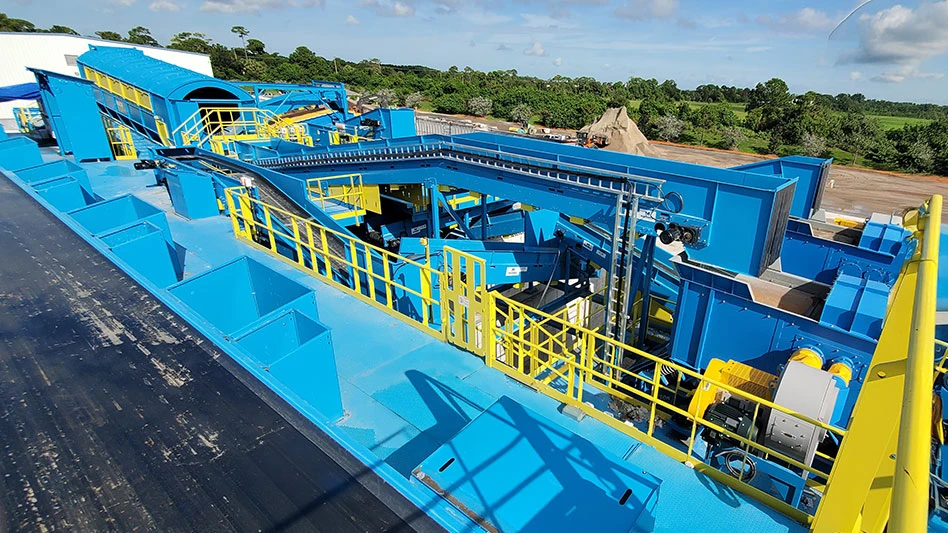
At the site, the county is using a sorting system with General Kinematics and Sherbrooke equipment to classify material into three sizes and capture recyclable metals, concrete and asphalt.
An initial setback, said Dorsey, have been soil test results indicating levels of petroleum that could preclude the reclaimed soil from being used in several applications. Asphalt paving and asphalt shingles in the landfill are the likely culprits, said Dorsey.
Although the project has yielded some marketable materials, Dorsey said the project has been operating at a loss, with expenses outweighing returns at about a 7:1 ratio. “That’s fine, if we can create airspace and move most of this material offsite,” he told attendees.
The 2011 C&D Recycling Forum was Sept. 25-27 at the Turf Valley Resort and Conference Center in Ellicott City, Md.
Latest from Construction & Demolition Recycling
- Waste Pro files brief supporting pause of FMCSA CDL eligibility rule
- Des Moines project utilizes recycled wind turbine blades
- Vecoplan to present modular solutions at IFAT 2026
- Terex Ecotec appoints Bradley Equipment as Texas distributor
- Greenwave raises revenue but loses money in Q2 2025
- Recycled steel prices hold steady
- John Deere launches ‘Building America’ excavator contest
- Triumvirate Environmental acquires Environmental Waste Minimization