Despite its key role as a sustainable activity, the recycling of C&D materials in certain end markets is facing serious environmental barriers in several New England states.
John Blaisdell, President of the New England Chapter of the Construction Materials Recycling Association (CMRA), outlined several challenges taking place in that region to attendees of the C&D World Conference, which took place in Miami in mid-January.
On the one hand, Blaisdell pointed out, a ban on the burial of concrete, brick, block, wood and several other C&D materials in Massachusetts should be providing a boon to recyclers. “There is a tremendous amount of infrastructure going into the New England region right now,” said Blaisdell, who is also a partner in the consulting firm Green Seal Environmental, Sandwich, Mass.
But even in the Bay State, there are still disposal options, he noted. “What keeps prices in check . . . is a lot of waste going out by rail and truck to Ohio, Pennsylvania and even South Carolina.” Blaisdell commented that there is a “tremendous amount of material going by rail to Ohio.”
While recyclers and out-of-state shippers battle for material, recyclers also face threats to their end markets for recycled wood fuel and the alternative daily cover (ADC) market for their mixed C&D fines.
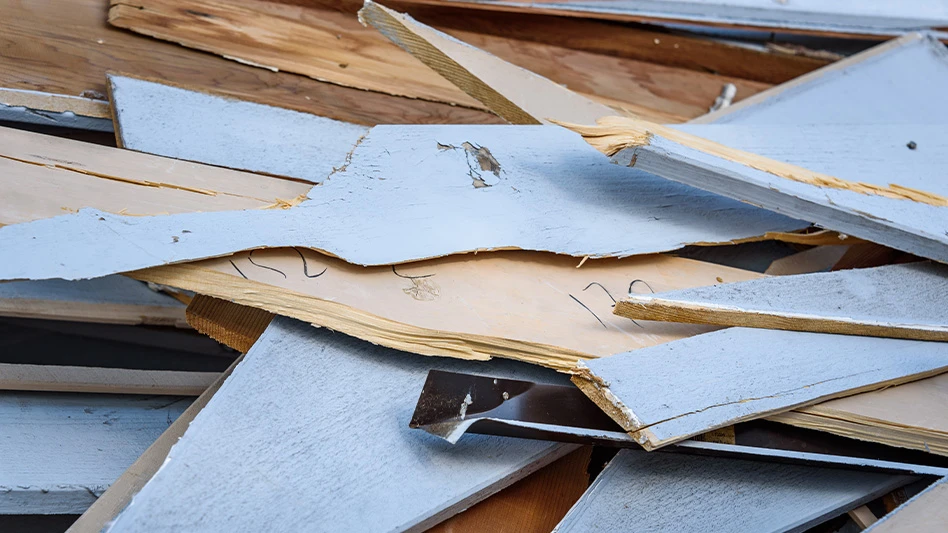
In the spring of 2005, New Hampshire imposed a moratorium on the burning of C&D wood as boiler fuel in response to concerns that such wood contained traces of hazardous substances. According to Blaisdell, the burning of C&D wood fuel at several existing and planned plants has been put on hold while a state study committee determines whether the fear of such hazards is real.
Maine has expressed similar concerns regarding C&D wood fuel and is considering requiring the testing of ever load for “non-combustible materials,” or metals. Blaisdell says if this requirement is put in place as currently proposed, it will mean a lot of time and energy for processors.
New England is also a battleground for the H2S (hydrogen sulfide) controversy surrounding the gypsum drywall portion of alternative daily landfill cover (ADC) created from mixed C&D fines.
Blaisdell says “the problem is real,” and resulted in one of the region’s largest customers for C&D ADC, the Cottage Street Landfill in Worcester, Mass., halting the use of the material.
Blaisdell and the CMRA are working to develop best management practices and conduct subsequent tests that can eliminate the H2S problem. “I am absolutely confident these products can be used successfully,” he remarked of C&D fines as use not only as ADC, but also as a remediated soil substitute in berms and embankments.
The C&D World Exhibition & Conference took place Jan. 15-17 in Miami. It is the official show of the Construction Materials Recycling Association and is managed by GIE Media Inc., publisher of Construction & Demolition Recycling magazine.
Latest from Construction & Demolition Recycling
- Vecoplan to present modular solutions at IFAT 2026
- Terex Ecotec appoints Bradley Equipment as Texas distributor
- Greenwave raises revenue but loses money in Q2 2025
- Recycled steel prices hold steady
- John Deere launches ‘Building America’ excavator contest
- Triumvirate Environmental acquires Environmental Waste Minimization
- Coastal Waste & Recycling expands recycling operations with Machinex
- Reconomy acquires German-based GfAW