Roughly half the cities in the region, plus the county, have adopted rules for construction and demolition recycling. At least two major waste companies are preparing to build facilities – one in El Cajon and the other in Chula Vista – to sort large loads of material from work sites.
"Everybody is looking at some type of an ordinance . . . because that is kind of the next step once you have done all the other programs to maintain your 50 percent," Lynn France said, referring to the state's minimum recycling threshold. She manages the environmental services program for Chula Vista.
Chula Vista officials originally wanted their construction recycling ordinance to start Tuesday, but they decided to wait for Allied Waste Industries to begin offering sorting services at the Otay Landfill. Now the program likely will take effect early next year.
Since April, San Diego has seen a substantial decrease in concrete, wood and other construction-related deposits at the Miramar Landfill. That's when new fees went into place to discourage dumping of construction and demolition products.
The next step – the one being rolled out July 1 – is to require developers and do-it-yourselfers to pay a deposit that they would recover after proving that at least 50 percent of their debris was recycled, reused or donated.
Deposits range from $200 for small projects, such as replacing a roof, to $200,000 or more for a large hotel remodel. The deposit would be $1,200 for a 3,000-square-foot home.
"It seems like it's taken quite a long time to put (the mandate) in place . . . however, we applaud the efforts," said Pauline Martinson, executive director of the nonprofit group I Love a Clean San Diego.
Since late last year, San Diego has introduced a package of measures designed to keep the city in compliance with California's recycling target. San Diego is at 55 percent, and city officials expect the construction recycling program to boost the number to 62 percent.
In February, San Diego focused on businesses and homes with a recycling mandate that will be phased in over the next two years. The city won't know the mandate's effectiveness until August, when waste haulers will file their first reports under the program.
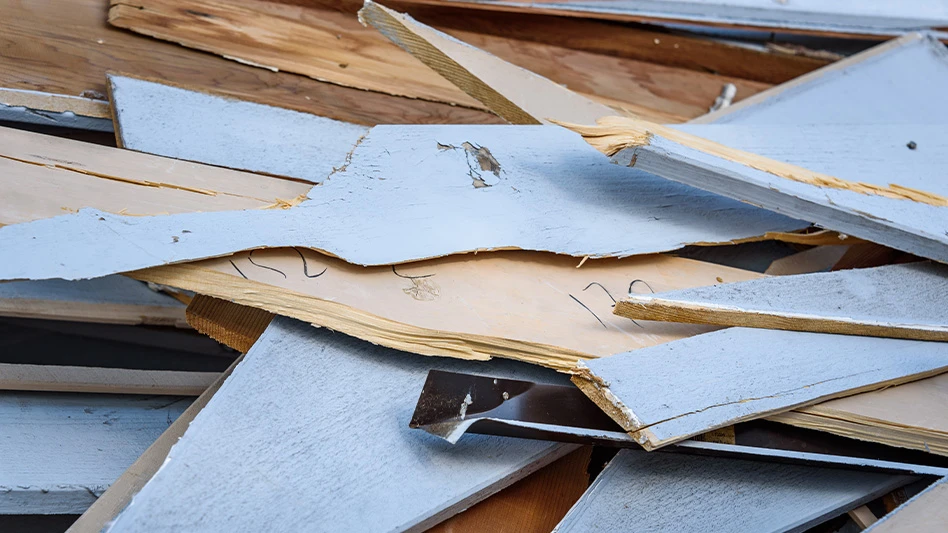
San Diego's other main effort is to divert construction debris toward recycling lines. That category – called C&D – includes drywall, lumber, concrete and other building products. About 400,000 tons of such materials have been thrown away at the Miramar Landfill annually, though the number has been falling as the economy slows.
The landfill could close as soon as 2012. San Diego officials are trying to expand its capacity and seek ways to extend its life span.
So far, businesses seem to be taking the C&D mandate in stride, partly because the construction market has been so slow and the recycling rules have been been formed over so many years that they aren't likely to surprise many companies.
"We haven't heard too much about complaints," said Angelika Villagrana, director of public policy for the San Diego Regional Chamber of Commerce.
Some businesses, mainly waste companies, welcome the chance to generate new or more revenue at their facilities that sort C&D debris. Those sites are considered crucial to the success of construction recycling programs because many builders don't have the space to separate their own waste materials.
"There's a call right now in the marketplace for (construction) material. There are a lot of things" that can be done with it, said Johnnie Perkins, a spokesman for Allied Waste Industries, which operates the Otay and Sycamore landfills.
For instance, drywall finds a second life as fertilizer. Concrete is reused for road foundations, and wood can be ground into mulch. San Diego Union Tribune
Latest from Construction & Demolition Recycling
- Vecoplan to present modular solutions at IFAT 2026
- Terex Ecotec appoints Bradley Equipment as Texas distributor
- Greenwave raises revenue but loses money in Q2 2025
- Recycled steel prices hold steady
- John Deere launches ‘Building America’ excavator contest
- Triumvirate Environmental acquires Environmental Waste Minimization
- Coastal Waste & Recycling expands recycling operations with Machinex
- Reconomy acquires German-based GfAW