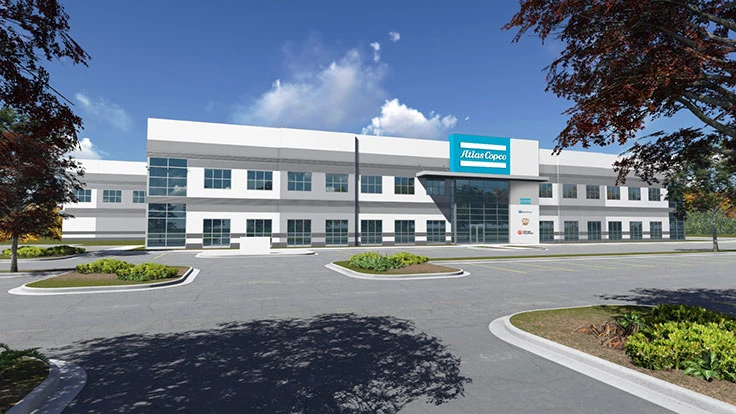
Atlas Copco, Stockholm, Sweden, inaugurates a manufacturing plant in the U.S. that will serve construction customers and hospitals.
Atlas Copco has invested $25 million in the brand-new factory in Rock Hill, South Carolina. The plant will manufacture portable compressors and generators for the construction market, as well as medical gas products for hospitals. Three hundred and thirty employees will work at the facility.
“This state-of-the-art factory will improve our production capabilities, enhancing productivity for our customers in North America,” says Andrew Walker, president of the construction technique business area.
Atlas Copco moved these operations from another facility in Rock Hill to this new building, which achieved a U.S. Green Building Council’s Leadership in Energy and Environmental Design (LEED) certification. The new facility includes the U.S. customer center.
Atlas Copco has invested $25 million in the brand-new factory in Rock Hill, South Carolina. The plant will manufacture portable compressors and generators for the construction market, as well as medical gas products for hospitals. Three hundred and thirty employees will work at the facility.
“This state-of-the-art factory will improve our production capabilities, enhancing productivity for our customers in North America,” says Andrew Walker, president of the construction technique business area.
Atlas Copco moved these operations from another facility in Rock Hill to this new building, which achieved a U.S. Green Building Council’s Leadership in Energy and Environmental Design (LEED) certification. The new facility includes the U.S. customer center.
Latest from Construction & Demolition Recycling
- Equipment finance index takes dip in March
- Nucor guidance points to profitable Q1
- Iron Bull introduces construction hoppers
- Sierra International Machinery adds to sales team
- Breedon Group to open two waste recovery and recycling sites
- Tariff criticism directed toward steel industry
- No dust ups
- On World Recycling Day, Allen Burns says C&D recycling progress depends on better data and sorting