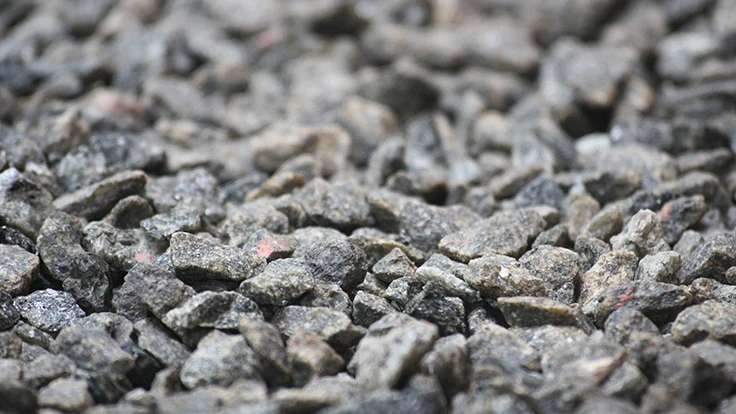
The National Stone, Sand & Gravel Association (NSSGA), Alexandria, Virginia, has announced that demand for aggregates shows a projected moderate increase through the years of the recently passed highway bill, the Fixing America’s Surface Transportation (FAST) Act.
The analysis, commissioned by NSSGA and performed by S-C Market Analytics, shows a corresponding increase in the demand for aggregates with increased federal dollars in the first few years. FAST Act impact peaks in 2018 and then projected higher interest rates and inflation reduce the impact of the federal program.
The FAST Act, adopted by Congress and approved by President Barack Obama in December 2015, injects $305 billion into the federal transportation budget from fiscal year 2016 through 2020. It is the first long-term investment in infrastructure in more than a decade. These funds will allow states to purchase and use an additional 114 million metric tons of aggregates, allowing more roads, highways and bridges to be built, improved and maintained, says NSSGA.
“The FAST Act’s five years of funding certainty creates the much-needed stability to enable state governments to plan and implement larger projects again,” says NSSGA President and CEO Michael W. Johnson. “The new highway bill, coupled with an increased demand for all types of construction, will require more raw materials, such as stone, sand and gravel. This is a good sign for the aggregates industry and for America.”
SC Market Analytics Executive Vice President and Chief Economist David Chereb, Ph.D., also broke down the forecast for individual regions and states.
Chereb says, “The Southeast, West, Mountain and some Northeastern regions of the U.S. fare the best under the FAST Act, whereas other states, especially those impacted by the fracking boom, face a pronounced correction.”
Unfortunately, S-C Market Analytics also predicts an economic decline starting in 2017 as higher interest rates, slowing China and Europe markets and low energy prices put a significant dent in demand for aggregates, says NSSGA.
“If the economists are right and a slowdown is on the way for 2017 and 2018, the funding certainty of the FAST Act will prove even more meaningful,” Johnson says. “I would hate for the federal highway program to be lurching from short-term extension to short-term extension again during a broad economic downturn.”
He adds that the fight over highway funding is not over because Congress failed to include a permanent and growing revenue solution.
Johnson says, “The nation’s infrastructure needs are far greater than the funding provided by the FAST Act. Unless we push Congress to address this shortfall, we will face the same funding cliff that we have had to deal with for the past decade as the program expires in 2020.”
To view the report in its entirety, a state-by-state breakdown, the impact on various construction sectors and a full analysis of the FAST Act, visit http://bit.ly/FASTActNSSGA.
NSSGA is a leading advocate for the aggregates industry. Its members—stone, sand and gravel producers and the equipment manufacturers and service providers who support them—produce the essential raw materials found in homes, buildings, roads, bridges and public works projects and represent more than 90 percent of the crushed stone and 70 percent of the sand and gravel mined annually in the United States. Production of aggregates in the U.S. in 2013 totaled more than 2 billion metric tons at a value of $18.6 billion, according to NSSGA.
SC-Market Analytics offers highly customized market forecasting, decision support and strategic consulting services to clients focused on the North American aggregates, cement and ready-mix concrete sectors. The company says it forecasts future consumption of these commodities from the individual county level up, allowing for full customization to each client’s unique served market area.
Latest from Construction & Demolition Recycling
- Vecoplan to present modular solutions at IFAT 2026
- Terex Ecotec appoints Bradley Equipment as Texas distributor
- Greenwave raises revenue but loses money in Q2 2025
- Recycled steel prices hold steady
- John Deere launches ‘Building America’ excavator contest
- Triumvirate Environmental acquires Environmental Waste Minimization
- Coastal Waste & Recycling expands recycling operations with Machinex
- Reconomy acquires German-based GfAW