Photo courtesy of Associated Builders and Contractors
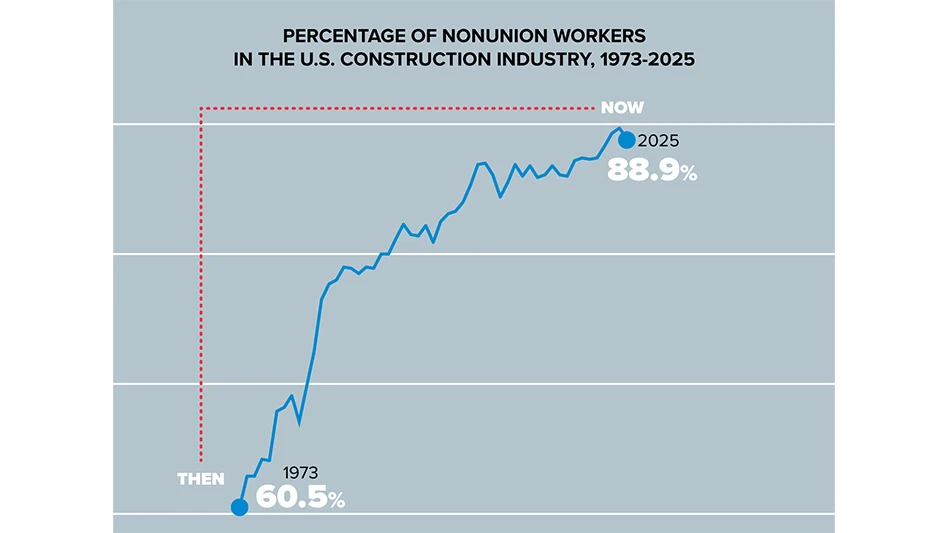
Nearly 90 percent of U.S. construction workers do not belong to a union, according to an Associated Builders and Contractors (ABC) analysis of the U.S. Bureau of Labor Statistics’ 2025 Union Members Summary.
The Washington-based trade association says 11.1 percent of construction members belonged to a union in 2025, which is an increase compared to 10.3 percent in 2024.
ABC says 995,000 construction industry workers were members of a union, while 8 million chose to pursue their careers in merit-based construction in 2025. The industry overall grew to 9 million workers in 2025.
“Merit shop construction employment reached an all-time high in 2025,” ABC President and CEO Michael Bellaman says. “This demonstrates that the overwhelming majority of construction workers prefer to work in an environment where they can pursue their individual professional goals by acquiring new skills through industry-driven multiskilling and advance their careers based on merit and their desires.”
According to ABC, the industry faces a workforce shortage of 349,000 in 2026, in addition to other major headwinds. Bellaman says this includes an aging and retiring workforce, immigration enforcement, high materials prices, tariffs, office vacancies and rapidly evolving technologies and innovation.
Bellaman added that one way President Donald Trump can give the contracting community immediate regulatory relief and preserve workers choice to not join a union is eliminating former President Joe Biden’s project labor agreements (PLA).
He argued that eliminating PLA mandates would save taxpayers an estimated $10 billion per year on federal and federally assisted construction projects simply by creating a fair and open competitive landscape where the full industry can participate.
“The supermajority of construction companies choose this employment relationship as they deem a merit-based culture the best way to attract talent and the most productive means to deliver long-lasting, high-quality projects at affordable prices,” Bellaman says. “Preserving this choice is imperative as the industry builds out America’s infrastructure and military as well as communities across the country.
Latest from Construction & Demolition Recycling
- Amrize sales hold steady for 2025
- Trucks & Parts names president
- Ferrous scrap supply squeeze said to have peaked
- CDE plant destined for Norway
- Astec Peterson rolls out new horizontal grinder
- In memoriam: Bruce Parker
- Vulcan reports increased revenue, earnings for 2025
- Heidelberg autonomous haul trucks reach milestone at Texas quarry