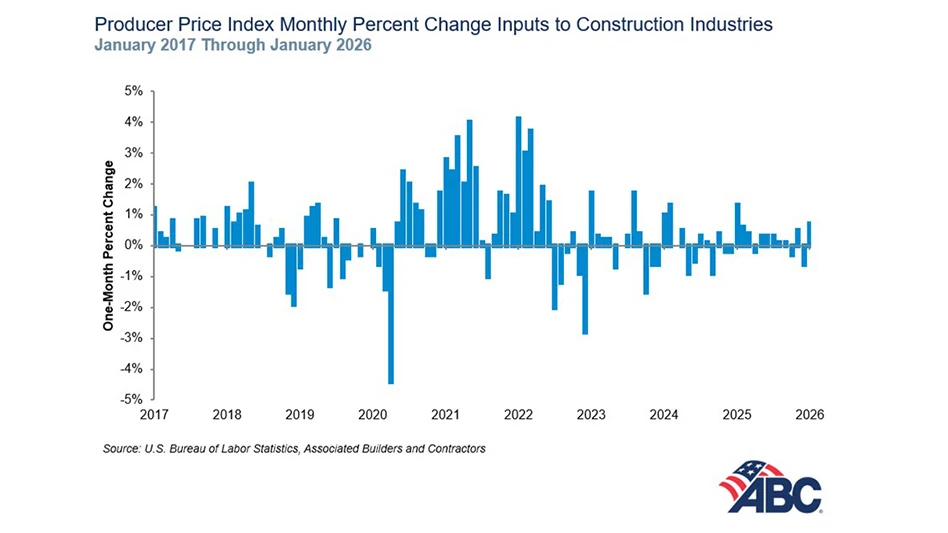
The Department of Labor Producer Price Index indicates that prices for construction materials increased by 2 percent in March, the largest monthly increase since July 2008, according to a news release from the Associated Builders and Contractors (ABC), Arlington, Va.
One of the key drivers for the price increases was oil, with a price hike of 14.8 percent.
ABC, in its monthly report, says that over the first quarter of 2011, construction material prices have increased by 4 percent and are 6.9 percent greater than March 2010 levels.
The ABC says steel mill product prices increased sharply for March, climbing by 5.3 percent from the previous month, rising 12.4 percent during the first quarter of the year. Steel prices are 15.3 percent higher than the same time in 2010.
Iron and steel prices increased 2.8 percent in March and 10.6 percent for the quarter, to reach levels 14.7 percent higher compared to last year. Prices for fabricated structural metal products saw a more modest increase of 0.8 percent in March and 2.9 percent over the first quarter, and are 5.1 percent greater than March 2010. Showing much more modest increases, prices for plumbing fixtures and fittings increased by 0.4 percent in March, 0.4 percent for the quarter and 1.8 percent year over year.
In contrast, prices for prepared asphalt, tar roofing and siding declined 0.4 percent for March, but were 0.3 percent higher for the quarter and 0.6 percent higher than the same time in 2010. Softwood lumber prices increased 0.5 percent in March and 1.4 percent for the first quarter, but are still 0.8 percent lower compared to March 2010. Concrete product prices stayed level for the month and fell 1 percent for the quarter, making them 0.7 percent lower than one year ago.
Crude energy prices declined 0.4 percent in March, but were up 2.4 percent for the quarter and 6.6 percent year-over-year. The 11.7 percent monthly decline in natural gas prices helped counter the 5.7 percent monthly increase in crude petroleum prices. Wholesale finished goods prices finished the month 0.7 percent higher, and were up 3.1 percent for the quarter and 5.7 percent compared to March 2010.
“Over the past nine months, the value of the U.S. dollar has slipped 8.3 percent, which tends to push commodity prices higher,” says Anirban Basu, ABC’s chief economist. “Today’s data comes as little surprise as a variety of commodity prices were rising throughout the month of March, including oil prices, which were up 14.8 percent. Iron and steel prices also saw solid increases, along with steel mill product prices.”
Basu continues, “There is more at hand than the value of the U.S. dollar. The global economy continues to expand at an above-average rate and actual and potential oil supply interruptions in Libya and Nigeria have also helped to motivate price increases in energy-related commodities.”
The end of March may show a change in pattern, though, says Basu. “In the last few days, many commodity prices have been falling. This is possibly a result of investors believing that these commodity prices have reached artificially high levels -- levels associated with a drastic downward shift in the demand curve. Many economists continue to believe that oil prices will eventually settle into a more comfortable range of $85 to $95 per barrel, although that may not happen until after the summer. Prices of other commodities are likely to follow suit, which would help support the eventual recovery in the U.S. private nonresidential construction industry,” Basu adds.
Latest from Construction & Demolition Recycling
- Greenwave raises revenue but loses money in Q2 2025
- Recycled steel prices hold steady
- John Deere launches ‘Building America’ excavator contest
- Triumvirate Environmental acquires Environmental Waste Minimization
- Coastal Waste & Recycling expands recycling operations with Machinex
- Reconomy acquires German-based GfAW
- CommanderAI launches HaulerCentral database
- Glass Recycling Foundation releases 2025 Impact Report