Photo provided by iStock.
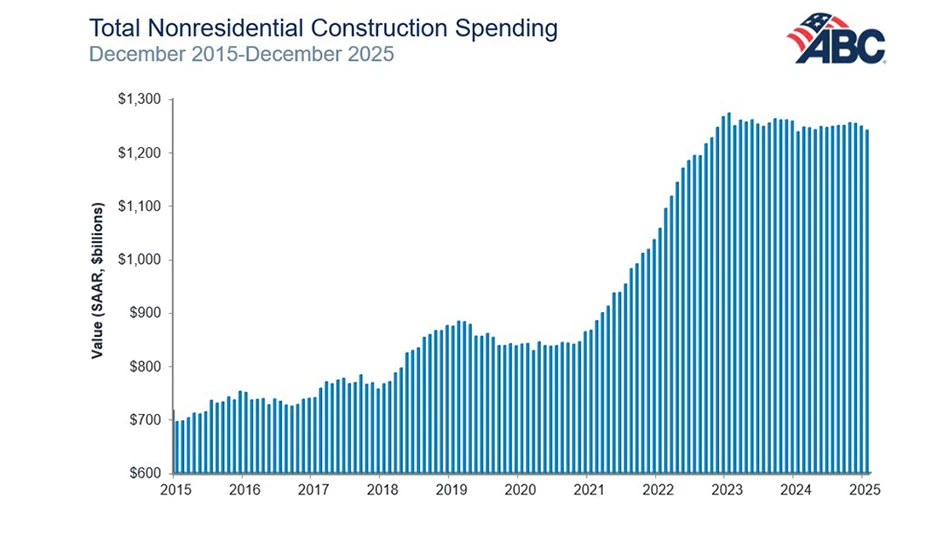
The Washington-based Associated Builders and Contractors (ABC) trade group says national nonresidential construction spending fell by 0.6 percent this May compared with April. Its chief economist says many contracting firms are unable to take on additional work.
Spending was down in May compared with April in 10 of the 16 nonresidential subcategories, according to ABC and United States Census Bureau statistics. Residential construction spending, on the other hand, was able to rise a slight 0.2 percent during the month.
Private nonresidential spending was down 0.4 percent while public nonresidential construction spending was down 0.8 percent in May. Nonresidential construction spending remains up 1.0 year-to-date compared with the first five months of 2021.
In the nonresidential sector year-to-date, the best performer is manufacturing, a segment in which construction spending is up 26.3 percent on a year-over-year basis.
“Many contractors continue to report that they are operating at capacity despite a lack of strong nonresidential construction spending recovery,” says ABC Chief Economist Anirban Basu. “That juxtaposition provides solid evidence that the supply side of the U.S. economy remains heavily constrained by worker shortages, domestic and global supply chain disruptions and resulting high prices.”
Continues Basu, “Since the early months of the pandemic, contractors have reported that they are able to pass along their cost increases to project owners, according to ABC’s Construction Confidence Index. But there are growing concerns among industry leaders that the ability to pass along cost increases will dissipate during the months ahead as financial conditions tighten and confidence in economic performance wanes.”
Going forward, “There is also a growing risk of a significant number of project postponements in both private and public construction segments due to high materials prices and labor costs,” states Basu.
“The key to sustaining nonresidential construction’s recovery will be slower inflation,” he continues. “As long as inflation remains elevated, monetary policy will continue to tighten and project owners will be less willing to move forward with projects in an effort to preserve cash. Less inflation and more favorable construction materials prices would create a foundation for renewed construction spending vigor.”
While construction tied to manufacturing space has been the brightest spot in 2022, the Census Bureau figures indicate the lodging sector has cooled off the most this year. Year-to-date, 11.7 percent less has been spent on building hotels compared with the same timeframe in 2021.
Latest from Construction & Demolition Recycling
- Vecoplan to present modular solutions at IFAT 2026
- Terex Ecotec appoints Bradley Equipment as Texas distributor
- Greenwave raises revenue but loses money in Q2 2025
- Recycled steel prices hold steady
- John Deere launches ‘Building America’ excavator contest
- Triumvirate Environmental acquires Environmental Waste Minimization
- Coastal Waste & Recycling expands recycling operations with Machinex
- Reconomy acquires German-based GfAW