New construction activity slowed in the month of June compared to the month before, but the highway and infrastructure category is holding up better than the residential and commercial segments.
According to construction contract value figures complied by the McGraw-Hill Construction division of The McGraw-Hill Cos., Lexington, Mass., new construction starts in June dropped 5 percent from May. Both non-residential and residential building showed moderate declines while non-building (infrastructure) construction was down only slightly from the previous month.
Even with the June swoon, for the first half of 2006 total construction on an unadjusted basis is up 7 percent relative to the same period one year ago. The residential segment may prove the most worrisome. “From 2001 through 2005, single-family housing had been the primary source of expansion for total construction, but that’s changed as the first half of 2006 clearly shows single family housing cooling down,” says Robert A. Murray, vice president of economic affairs for McGraw-Hill Construction.
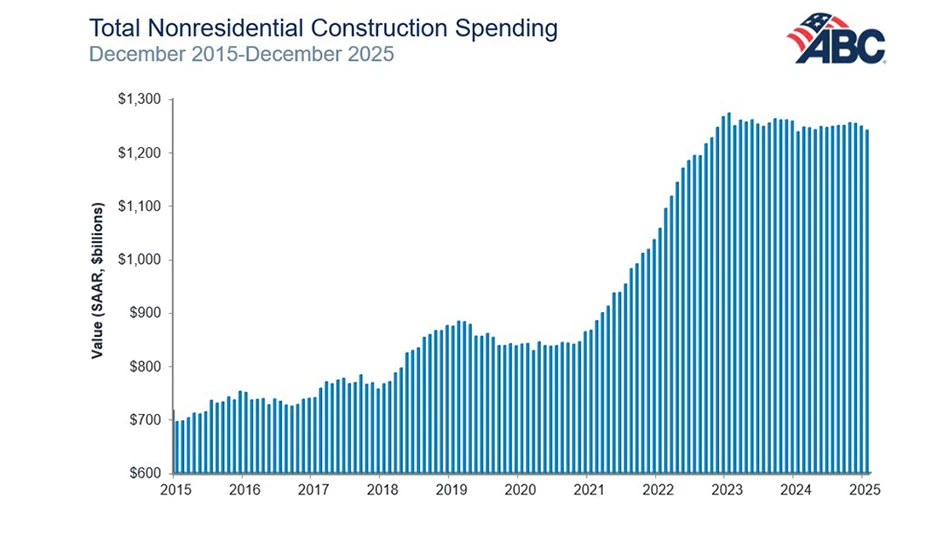
“At the same time, the upturn for nonresidential building has gained momentum in 2006, as improved market fundamentals have encouraged further development, even amidst the difficulties arising from the higher cost of materials. In addition, greater federal spending and the improved fiscal position of the states have contributed to more public works construction this year,” adds
The infrastructure (non-building) segment has been the most stable, receding just 1 percent in June. Highway spending was down 6 percent in June compared to May, but growth was reported in bridge construction (up 12 percent) and in the sewers segment (up 4 percent).
The “miscellaneous public works” category was a big gainer at 60 percent largely because of the start of two large baseball stadium projects: One for the New York Mets in Queens with an estimated construction start cost of $600 million, and the other for the Washington Nationals in
During the first six months of 2006, non-building construction advanced 13 percent over the previous year. Highway construction has been up 20 percent, reflecting support from having the multi-year federal transportation bill in place as well as healthier state budgets.
Although non-residential building in June slipped 4 percent, it was in comparison to a very strong month of May. Within the commercial sector, store construction fell 22 percent from a strong May, and a decline was also reported for office construction (down 6 percent). Among major projects that helped keep the June figure strong were office projects in
Hotel construction was boosted by $1.3 billion related to the hotel portion of the massive Encore at Wynn hotel/casino resort in Las Vegas plus large hotel projects in Atlanta, Chicago, Grapevine, Texas, and Portland, Ore.
Two large airport terminal projects also gave construction spending a boost, with contracts being extended at airports in
For the first half of the year, the value of non-residential building contracts has increased 17 percent compared to the first half of 2005, according to McGraw-Hill.
On the housing side, the value of new residential contracts dropped 6 percent in June, compared to May, with the increased cost of financing cited as the major culprit. “While the retreat for single-family housing may still be viewed as orderly, there’s no question that a weakening trend has taken hold that will continue into the second half of 2006 and probably into 2007,” says Murray.
Multi-family housing in June dropped 17 percent from a strong May, although throughout the first half of the year the market has been a strong one.
In this year’s first half, residential building contract values are up 1 percent versus last year. By structure type, single-family housing is down 1 percent in the first half of 2006, while multi-family housing is up 8 percent.
Ranked by the dollar volume of new construction starts, the top five metropolitan areas for multifamily housing in the first half of 2006 and their year-over-year growth patterns have been New York (up 10 percent); Miami (down 8 percent); Chicago (up 6 percent); Los Angeles (up 45 percent); and Las Vegas (up 58 percent).
For construction across all categories, the 7 percent increase reported for the
Latest from Construction & Demolition Recycling
- Vecoplan to present modular solutions at IFAT 2026
- Terex Ecotec appoints Bradley Equipment as Texas distributor
- Greenwave raises revenue but loses money in Q2 2025
- Recycled steel prices hold steady
- John Deere launches ‘Building America’ excavator contest
- Triumvirate Environmental acquires Environmental Waste Minimization
- Coastal Waste & Recycling expands recycling operations with Machinex
- Reconomy acquires German-based GfAW