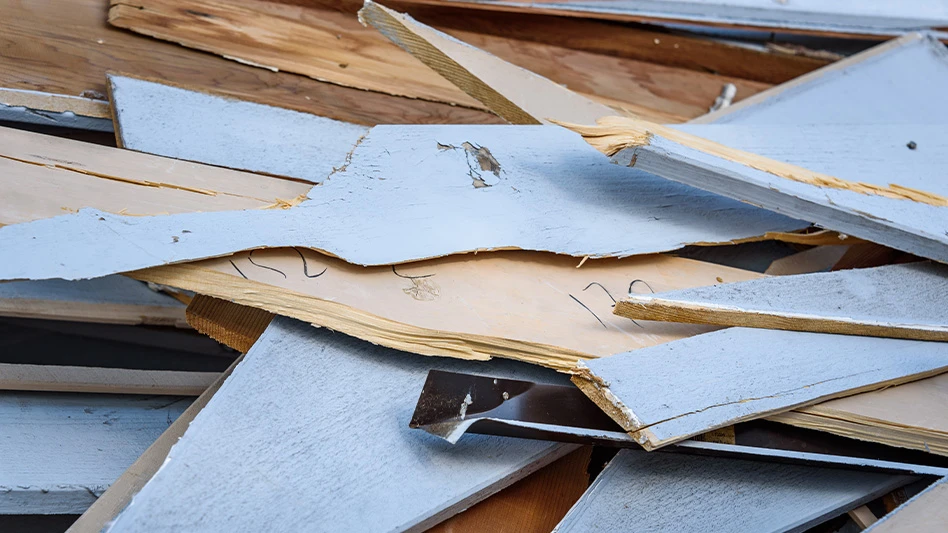
The Northeast Waste Management Officials’ Association (NEWMOA), with support from a $25,000 Environmental Protection Agency (EPA) grant it received in 2008, has published a white paper to increase the amount of gypsum wallboard scrap that is recycled in the Northeast.
The report, Policy Options White Paper Promoting Greater Recycling of Gypsum Wallboard from Construction and Demolition (C&D) Projects in the Northeast, was prepared by NEWMOA and is the culmination of input from the association, eight Northeast states and the EPA throughout the past two years.
The study supports the discussion among the states on key strategies that could be implemented within a state or across the region to advance gypsum wallboard recycling.
NEWMOA’s board of directors is in the process of identifying next steps for the association to pursue.
NEWMOA estimates that 1.2 million tons of gypsum wallboard scrap were generated in the Northeast in 2006, of which about 720,000 tons were new gypsum wallboard scrap from construction projects, and 480,000 tons were old wallboard removed from demolition and renovation projects.
The NEWMOA white paper identified the following strategies that states could adopt to significantly improve gypsum recycling in the foreseeable future:
• Banning the disposal of gypsum wallboard in landfills;
• Requiring recycling of gypsum wallboard scrap produced by state-financed projects;
• Requiring waste management planning by construction industry contractors so that they are better prepared to properly manage and recycle construction and demolition debris, including wallboard;
• Developing common terminology and reporting requirements among state environmental agencies to help wallboard and other C&D waste processors and recyclers conduct business more easily in neighboring states and so that environmental agencies and others can obtain an accurate understanding of the quantities and rates of gypsum recycling in the region; and
• Developing and implementing extended producer responsibility approaches to engage the manufacturers and other stakeholders in promoting increased recycling of gypsum wallboard.
Several Northeast states have already adopted some of the above strategies. For example, the Massachusetts Department of Environmental Protection has proposed a disposal ban on clean gypsum wallboard and is in the process of preparing responses to the comments received during public hearings in June 2010. And state contracting programs in Massachusetts and Maine require C&D materials recycling in state construction projects and include new construction wallboard scrap specifically. More examples of the strategies adopted in the Northeast are available at www.cdrecycler.com/northeast-targets-gypsum-recycling.aspx.
Explore the November 2010 Issue
Check out more from this issue and find your next story to read.
Latest from Construction & Demolition Recycling
- Vecoplan to present modular solutions at IFAT 2026
- Terex Ecotec appoints Bradley Equipment as Texas distributor
- Greenwave raises revenue but loses money in Q2 2025
- Recycled steel prices hold steady
- John Deere launches ‘Building America’ excavator contest
- Triumvirate Environmental acquires Environmental Waste Minimization
- Coastal Waste & Recycling expands recycling operations with Machinex
- Reconomy acquires German-based GfAW