When a fire damaged a critical Cincinnati bridge that carries about 100,000 daily commuters and freight haulers between Kentucky and Ohio, the Ohio Department of Transportation (ODOT) tapped The Great Lakes Construction Co. to complete the emergency bridge reconstruction project.
While a major bridge reconstruction typically takes two to three years, the Hinckley, Ohio-based heavy civil construction company with an office in Cincinnati expedited the process, working with collaborators to restore the bridge in just over three months.
“Working collaboratively with the state and also the design firm and a lot of our vendor partners, we were able to get traffic reopened in 100 days,” says Tom Hackett, a project manager for The Great Lakes Construction Co. who focuses on alternative delivery procurement models associated with design and construction on emergency projects.
On Nov. 1, a devastating fire broke out beneath the Daniel Carter Beard Bridge, commonly known as the “Big Mac bridge” for its two yellow arches across the span carrying Interstate 471 over the Ohio River, compromising the bridge’s southbound approach. The fire spread quickly, melting seven steel girders and more than 7,600 square feet of concrete deck.
The intentionally set fire caused $11 million in damage to the bridge and road and another $2 million in damage to city property, according to court documents, making it one of the most expensive arson fires to occur in the area.
ODOT contracted with The Great Lakes Construction Co. as well as an engineering design firm, E.L. Robinson Engineering, Charleston, West Virginia, to take on the emergency-style contract.
“What was unique about it was it was more of like a design assistance contract,” Hackett says. “The state of Ohio, the design firm that the state hired and [The Great Lakes Construction Co.] all worked hand in hand throughout the development of the procurement, the design and the construction, and we all used each other’s expertise to fast-track all three of those things.”


The demolition
A portion of the superstructure of the Daniel Carter Beard Bridge, originally built in the 1970s, had to be removed before reconstruction could begin. This included the concrete parapet, the concrete deck and several existing steel girders, Hackett says. The company hired a specialty engineering firm that focuses on complex engineering challenges to tackle the demolition.
“This was a unique challenge,” Hackett says. “Several of the steel girders were melted from the fire beneath the bridge, so the structural capacity wasn’t typical for what we would expect in a normal demolition process.”
The engineering firm analyzed the project, and the two firms worked together with the state to develop a detailed demolition plan.
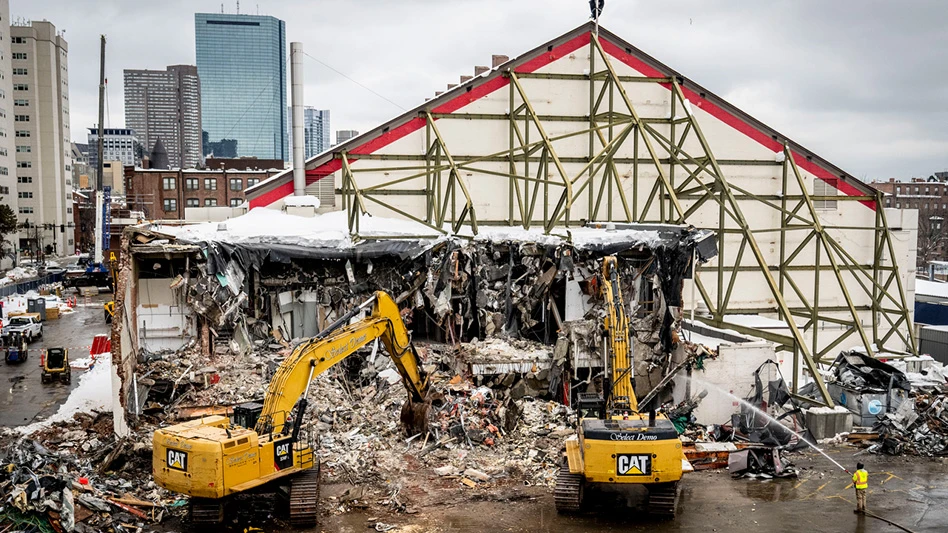
Crews completed a surgical demolition to remove the damaged bridge structure, using a Komatsu PC360 excavator, a Sany 365 excavator with a mobile rotating pulvertizer and a Liebherr LTM 1450 crane to “munch” the deck in place in certain areas.
“Once we got out of the areas where the steel had deformed, it turned into a more traditional demolition with saw-cutting the concrete deck and then using an excavator to remove the steel or the concrete slabs,” Hackett says. “Then we used a crane to pick and lower the existing girders.”
More than 144,000 pounds of steel, 32,000 pounds of rebar and 5,600 pounds of aluminum were transported to local scrapyards for recycling.
The reconstruction
Once the damaged bridge structure was removed, rebuilding could begin. The Great Lakes Construction Co. ordered new steel girders and new bronze bearings, Hackett says, while also refurbishing many of the existing bearings that were damaged in the fire.
When the girders and bearings were in place, crews were able to start forming and pouring the deck and placing the new parapet before opening the bridge back up to traffic.
The Great Lakes Construction Co. team completed a thorough and detailed engineering analysis to determine the most appropriate way to remove damaged sections of the bridge with safety in mind.
Safety precautions included installing shoring towers to help stabilize the structure, Hackett says. The construction company also brought mobile tying-off points to the site and installed them on the deck during demolition for workers who were walking around the site.

Project challenges
To meet the Big Mac project’s ambitious 100-day schedule, construction crews worked 24/7 through wintery weather, including below-zero temperatures and arctic blasts, Hackett says. Racing against time to complete the engineering and design phases, followed by constructing and manufacturing bridge elements at the required pace, were challenging, to say the least, Hackett adds.
The biggest challenges were the aggressive timeline set by the state of Ohio and negative public sentiment from commuters facing daily gridlock and local businesses cut off from customers fearing a multiyear closure.
To overcome intense public pressure, The Great Lakes Construction Co. was proactive in providing public information, working with state and local agencies to offer regular updates through press conferences, social media and direct engagement.
“The public wanted it done immediately,” Hackett says. “You couldn’t have done it fast enough for a lot of the people in the city that were used to using the bridge every day.”
Another major hurdle was pouring a new concrete bridge deck in January. Pouring concrete in subfreezing temperatures is difficult, requiring heated enclosures, chemical admixtures and additional planning to ensure proper curing.
“We ran into a lot of weather challenges coming out of December and into January and February—that’s when there were several arctic blasts that came into town,” Hackett says. “We had subzero temperatures that we worked through for some of the demolition and the forming and during the concrete deck pour as well. We worked through all of that—normally we wouldn’t, but since it was an emergency situation, we did.”
When the Big Mac bridge successfully reopened Feb. 9, far ahead of the company’s initial projections, Hackett says the public response of gratitude was overwhelming.
For The Great Lakes Construction Co., the achievement underscores its dedication to ensuring safe, efficient and resilient infrastructure. The most rewarding part of the project, Hackett says, was the teamwork.
“All the vendors, the state, the designer, the contractor—everybody that was involved in the project—prioritized the project and pushed their other work aside to focus on this one project and really put the focus on teamwork to get it done. Otherwise, it never would have been done that fast,” Hackett says. “We really appreciate the dedication and teamwork from everybody at Great Lakes, ODOT, E.L. Robinson and all of our vendor partners that really helped push this thing through.”

Explore the July/August 2025 Issue
Check out more from this issue and find your next story to read.
Latest from Construction & Demolition Recycling
- Sybilion seeks to help manufacturers confidently address volatility
- Construction backlog rebounds in February
- USTR to study additional steel, aluminum tariffs
- Shawmut commemorates National Women in Construction Week
- Holcim expands presence in Colombia with agreement to acquire Cemex operations
- eFactor3 enters into separation tech partnership
- Mitsubishi Logisnext Americas to rebrand as Logisnext Americas
- Burns Services diverts more than 1.2M tons of C&D materials from landfills