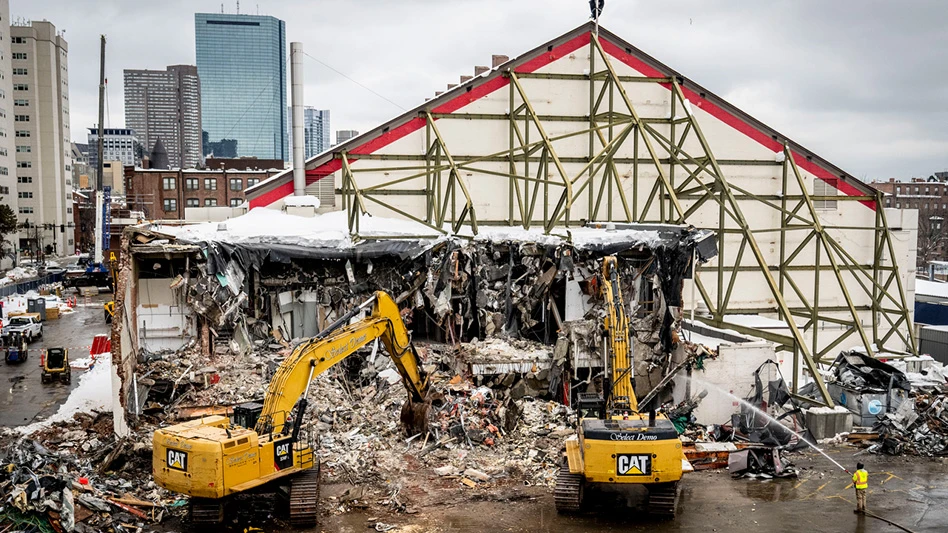
There was a time in demolition when a pile of busted-up concrete marked the end of a story—a mess to haul away.
Not anymore.
Across North America, demolition and construction crews are trading dump runs for crusher buckets. They are transforming concrete debris into reusable aggregate. This trend is rapidly expanding as contractors discover that those same piles of rubble can become the start of something better: new revenue, lower costs and a cleaner planet.
In most cases, all it takes is a carrier, the right attachment and a single operator.
Thousands of miles apart, two contractors share one revelation: Waste isn’t waste anymore. They’re saving thousands per job, tightening project timelines and proving that sustainability doesn’t have to mean sacrifice; it can mean profit.
Breaking the haul-and-replace habit
Nick Bakken, who runs operations for SommerCal Construction, based in Sparks, Nevada, knows all too well how quickly disposal costs can eat up a job’s profit.
“We had a lot of demo jobs coming up where we knew we’d be getting a ton of concrete in,” Bakken says. “The last thing we wanted to do was pay to haul and dump it, then turn around and buy back rock for our flatworks. That just didn’t make sense anymore.”
SommerCal Construction handles everything from site prep to flatwork and demolition. Like many midsize contractors, it was stuck in a cycle of paying to dispose of old concrete and then paying again to bring in new aggregate. The solution arrived in the form of an MB-L140 crusher bucket for the company’s skid steer—a model designed for compact carriers but capable of serious throughput manufactured by MB Crusher, an Italian company with a North American branch in Reno, Nevada.
SommerCal purchased one of the crusher buckets for its skid steer, and it fit right into the company’s workflow. SommerCal didn’t need to buy or transport a big, dedicated crusher; it simply hooked up the bucket to the skid steer and started processing. Suddenly, every slab the company tore out became a source of usable base material. Crushed concrete from one project could go straight into the next, creating a circular, jobsite-level recycling loop.
Between fuel, dump fees and material costs, the company had been losing a couple thousand dollars per job just moving material around. Now, by crushing concrete using its skid steer, that material became reusable aggregate. SommerCal also knew exactly what was going into its backfill and avoided delays related to deliveries or dump schedules and kept the workflow moving smoothly.
From intuition to innovation in Québec
Over 2,000 miles away in Marieville, Québec, Sylvain Touchette with the firm Excavation Touchette was having a similar revelation—though his started with what he calls “an intuition.”
At ConExpo in Las Vegas, Touchette purchased his first MB Crusher BF70.2 jaw crusher, mounted it on his excavator and began crushing concrete from his demolition jobs. What began as a hunch quickly evolved into a business-changing practice.
“When it comes to recycling, we all know how expensive it is to dump a ton of concrete and then buy new material to build parking lots,” Touchette says. “Instead, I chose to reuse it.”
Concrete demolition rubble now provides free fill material.
By transforming demolition debris into ready-to-use aggregate, Touchette effectively eliminated his raw material costs. His crusher paid for itself in just two years, and every ton he processes now goes straight into profit or into the next project’s base layer.
While some demolition firms pay to get rid of material piling up on their jobsites, Touchette decided to turn it into savings and new income. He literally crushed his company’s costs.

The attachment advantage
Bakken and Touchette found that the real breakthrough wasn’t just in the idea of recycling concrete but in choosing the right attachment. Pairing the correct bucket with the right machine is where efficiency, durability and payback all come together.
For Bakken, that meant a crusher bucket built to match the hydraulic flow and power of his skid steer. Compact enough to move easily between sites but strong enough to chew through reinforced slabs, it hit the sweet spot between mobility and muscle for SommerCal.
In Québec, Touchette’s setup looked different but followed the same logic. His BF70.2 jaw crusher mounted on an excavator gave him more reach and crushing power, ideal for larger demolition jobs and consistent aggregate sizing.
Both contractors learned that success comes from measuring the full savings, not just production rate. The right attachment matched to the right carrier can unlock huge efficiencies.
A compact jaw crusher bucket also can be accessorized with a ferrous separator, which saves hours of cleanup, or a dust suppression kit to reduce dust emissions. Using more of the heavy equipment in the fleet translates directly into return on investment. With crusher buckets in place and workflows refined, contractors can turn a recurring expense into a renewable source of material and profit.
Smarter workflows, cleaner jobsites
Both companies now run tighter operations, crushing debris as it’s generated. Jobsites are cleaner, safer and more organized, with fewer trucks, less dust and minimal waiting.
What’s striking about these stories isn’t just the technology, it’s the mindset shift. Contractors are embracing circular construction, where materials from one phase of a project directly fuel the next.
C&D debris accounts for hundreds of millions of tons each year in North America. Recycling it on-site cuts landfill use, trims transportation emissions and conserves natural aggregate while making financial sense.
For clients and municipalities pushing greener building practices, those benefits are becoming a requirement, not a bonus.
Crushing it and the competition
These experiences highlight a clear trend: The future of demolition and C&D recycling is smaller, smarter and more circular. What used to take a crushing spread the size of a football field now can happen with one attachment and an existing machine. Contractors are proving that profitability and sustainability can coexist.
“It’s one of those things where once you start doing it, you realize how much sense it makes,” Bakken says. “You wonder why you didn’t do it sooner.”
From intuition to innovation, a new generation of contractors is proving that every pile of rubble holds opportunity. In an industry that measures success in tons, that’s a lot of potential waiting to be crushed.
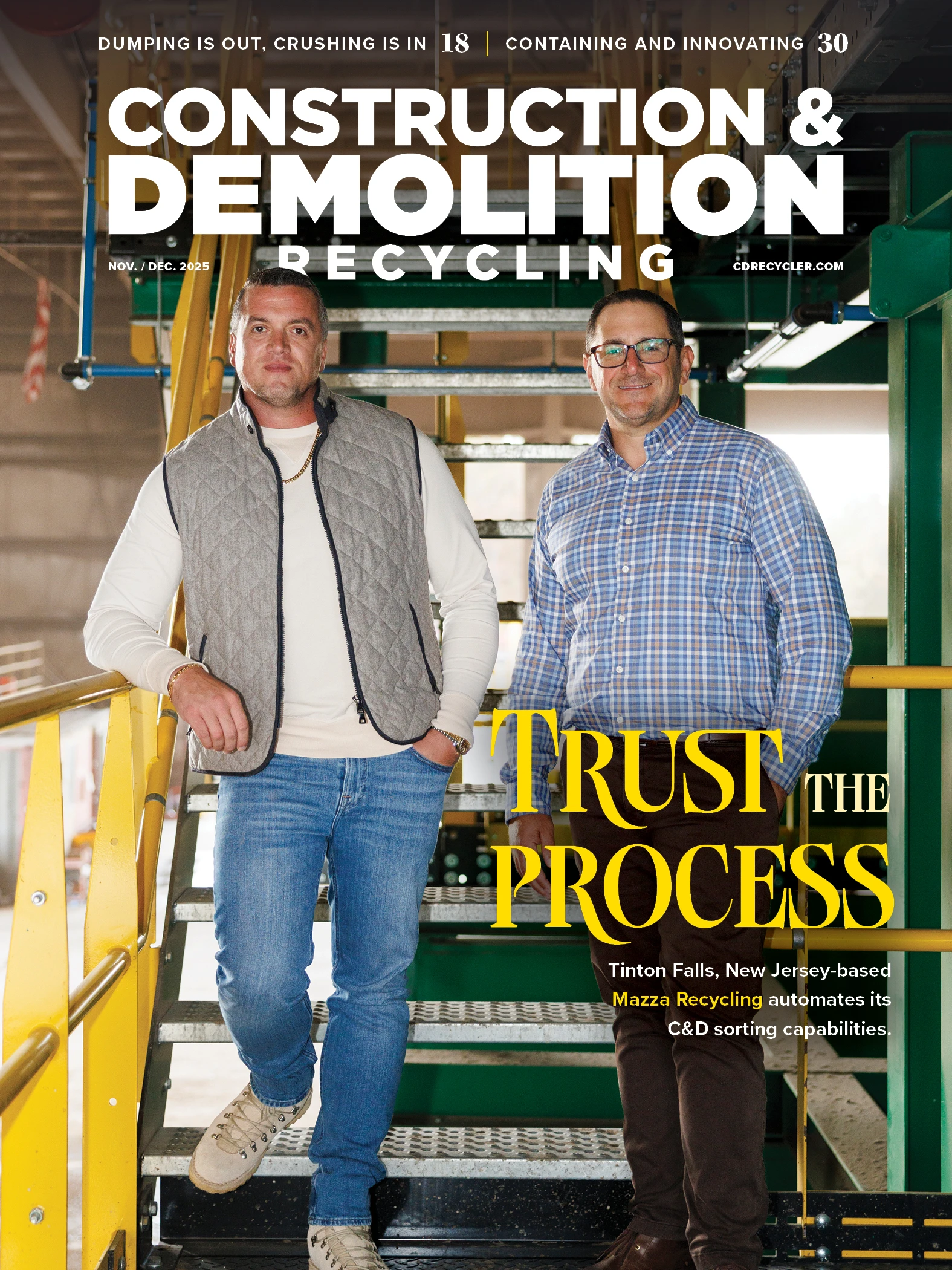
Explore the November/December 2025 Issue
Check out more from this issue and find your next story to read.
Latest from Construction & Demolition Recycling
- Sybilion seeks to help manufacturers confidently address volatility
- Construction backlog rebounds in February
- USTR to study additional steel, aluminum tariffs
- Shawmut commemorates National Women in Construction Week
- Holcim expands presence in Colombia with agreement to acquire Cemex operations
- eFactor3 enters into separation tech partnership
- Mitsubishi Logisnext Americas to rebrand as Logisnext Americas
- Burns Services diverts more than 1.2M tons of C&D materials from landfills